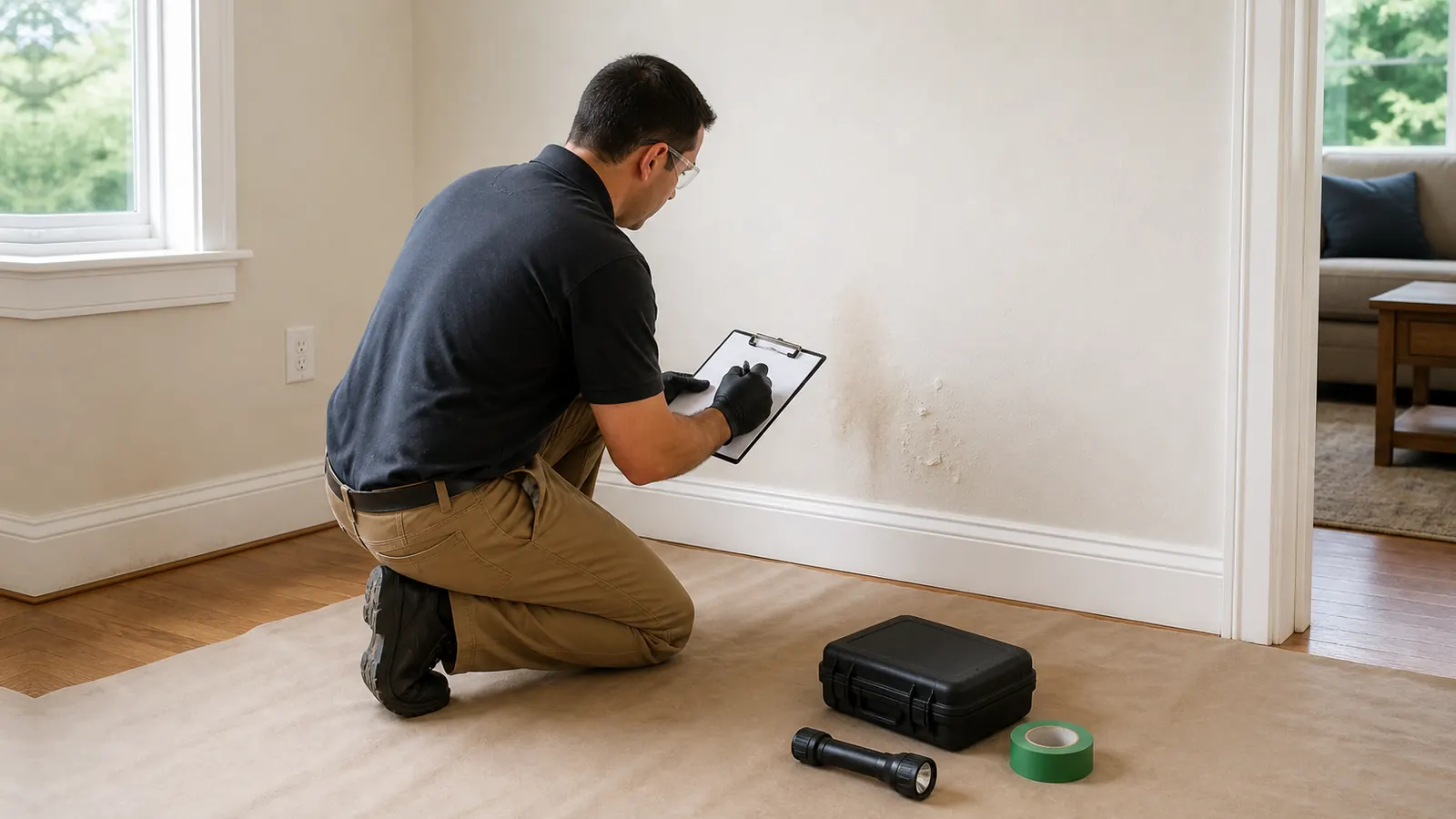
Sources and local requirements checked August 9, 2026. The response sequence below is deliberately conservative. A remote article cannot classify the water, clear an electrical hazard, find a concealed source, or decide which materials are salvageable.
| What you observe | First call | What that call should establish |
|---|---|---|
| Water continues with all fixtures off; meter or supply noise suggests pressure-side flow | Plumber now | Safe isolation, failed component, access point, and whether the building supply must remain off. |
| Leak appears only when a sink, toilet, tub, shower, washer, or dishwasher runs | Plumber or appliance service | Whether the source is a supply, fixture seal, drain, hose, appliance, or connection. |
| Leak follows rain or wind and no plumbing use | Envelope specialist | Entry point at a window, wall penetration, cladding, flashing, or another exterior transition. Esquives does not offer roofing. |
| Wet switch, receptacle, junction box, light, or electrical equipment | Qualified electrician | De-energization and evaluation before the equipment or circuit returns to service. |
| Source is stopped but insulation, drywall, framing, or flooring remains wet | Restoration and general-contractor coordination | Moisture extent, contamination limits, selective opening, drying records, and a rebuild scope. |
The first ten minutes: control hazards, not finishes
A hidden leak creates two separate problems. Water is still entering, and building materials are holding water that already arrived. The first problem can expand every minute. The second cannot be solved by painting, caulking, or waiting for the stain to fade. Work in that order.
- Stop activities that correlate with the leak. Turn off the faucet, shower, toilet, washer, dishwasher, irrigation zone, or other device that was running when the symptom appeared. Do not keep testing it just to produce a better video.
- Isolate water if the flow continues. A reachable fixture valve may control a toilet, sink, or appliance. An uncontrolled pressurized leak may require the building's main water valve. If you do not know the valve or cannot approach it safely, call a plumber or the water utility rather than improvising.
- Protect people first. Keep children and pets away. Do not touch wet electrical devices. Do not stand beneath a bulging ceiling or beside a wall whose surface is swelling or separating. Move unaffected belongings only from a dry, stable path.
- Document before appearances change. Photograph the first visible stain, floor water, affected baseboard, nearby fixtures, and the valve position. Note the time, recent fixture use, rain, appliance cycles, odors, sounds, and what changed after isolation.
- Call for source control. Tell the responder whether the water is active, whether it changes with fixture use, which valves are off, whether electrical components are wet, and whether the surface is bulging. Those facts are more useful than guessing that the pipe is directly behind the stain.
Place a container beneath an ordinary drip only if the floor is stable, the water is not contacting electricity, and the container can be positioned without touching damaged material. Do not puncture a wet wall or ceiling as a general homeowner step. A cut can contact wiring or piping, release contaminated water, disturb older hazardous materials, or remove the evidence needed to trace the route.
Use timing and fixture patterns to narrow the source
Water follows gravity, framing, pipe surfaces, fasteners, insulation, and openings. It can travel sideways before it appears. That is why the wettest paint is a starting point, not a source diagnosis. A better investigation pairs the symptom with the event that produces it.
Continuous flow points toward a pressurized source
If water continues while drains and appliances are idle, a cold- or hot-water supply, failed valve, connector, or pressurized appliance line moves higher on the list. Closing a fixture valve and observing whether the symptom stops can isolate a branch without opening the wall. A plumber may also compare meter behavior and use pressure or acoustic testing. None of those observations alone proves the exact failed fitting; together they reduce unnecessary demolition.
Flow during fixture use points toward a drain or fixture seal
A stain that appears only when an upstairs tub drains, a toilet flushes, a dishwasher discharges, or a washing machine pumps out behaves differently. The water may come from a drain joint, overflow, fixture connection, wax seal, pan, grout transition, or appliance hose. Run tests should be controlled by the qualified person because repeated testing adds water to the assembly.
Rain-linked moisture points toward the exterior envelope
A wall that gets wet after wind-driven rain may be receiving water at a window, door, wall penetration, balcony transition, cladding joint, or flashing detail. The visible interior mark may sit below or beside the entry point. Photograph wind direction and rainfall timing. Do not accept a sealant-only proposal until the path and drainage detail have been considered. Esquives does not offer roofing, so suspected roof entry should be referred to an appropriate roofing professional.
Intermittent condensation can imitate a leak
Cold piping, poorly insulated ducts, or humid indoor air can create surface moisture without a failed pipe. Condensation tends to follow operating conditions and temperature, while a pressure leak may continue independently. That distinction still needs evidence. Calling every damp wall “condensation” without measuring the surrounding conditions can postpone a real repair.
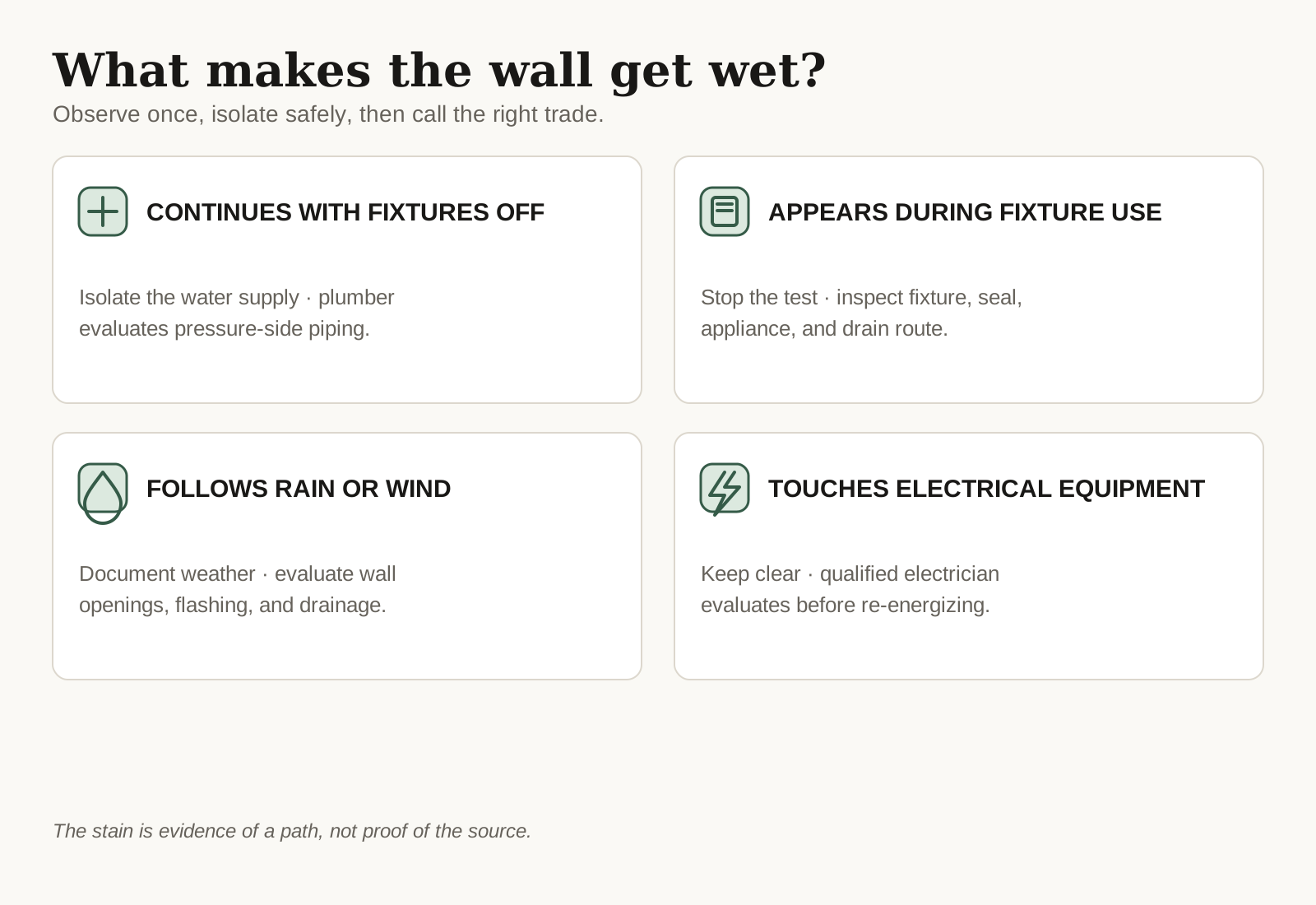
Who should you call first?
The first contractor should be able to stop or prove the source. A general contractor is valuable when the loss crosses several trades, but source control still belongs with the relevant specialist. A clear handoff prevents the plumber, electrician, drying team, and finish crew from each assuming another person verified the hidden work.
Call a plumber for supply, fixture, or drain evidence
Choose a plumber when water use changes the symptom, a valve or connector has failed, pressure-side flow continues, or the suspected path involves domestic water or drainage. Ask for the failed component, isolation method, repair performed, test used after repair, access opened, and whether any concealed piping was replaced. That record guides both drying and local permit review.
Call an electrician when water reached electrical components
The Electrical Safety Foundation International states that returning water-damaged equipment to service without proper evaluation can create shock or fire risk. A dry-looking switch or receptacle is not a field clearance. Tell the electrician what was wet, whether the circuit is energized, and whether the component was submerged, sprayed, or exposed within the cavity.
Call a restoration professional for water mapping and drying
Source control does not remove water from insulation, framing, drywall, flooring, or adjacent rooms. A restoration scope should identify the water source, affected materials, contamination concern, readings or comparisons used, planned openings, drying equipment, monitoring record, and completion criteria. Equipment placement without an initial map and follow-up record leaves the next contractor guessing.
Call a general contractor when the assembly must be rebuilt
A general contractor coordinates selective demolition, framing or sheathing repair, insulation, plumbing and electrical access, drywall, texture, trim, cabinetry, and paint. That becomes important when the wall is structural, fire-rated, sound-rated, exterior, tiled, cabinet-backed, or part of a kitchen or bathroom. Reconstruction should restore the duties of the full assembly, not just cover the opening.
When should the wall be opened?
Opening is justified by evidence, not a universal cut height. The goal is the smallest safe opening that allows the failed component to be repaired, wet materials to be reached, the cavity to be inspected, and the required assembly to be restored. A plumber may need one access point while drying or insulation removal requires a different boundary.
EPA's current clean-water table says wallboard may be dried in place when there is no obvious swelling and the seams are intact, with wall-cavity ventilation if possible. Otherwise it says to remove, discard, and replace the wallboard. The same table treats fiberglass and cellulose insulation differently by directing discard and replacement. That means an intact face does not automatically spare the wall from a controlled opening.
The EPA also explains that its 24–48-hour language is guidance for quick response and mold prevention, not a clock that decides every wall. Mold can occur within that period, and it may not occur afterward. The correct conclusion is to act promptly and verify conditions, not to promise “no mold” or order blanket demolition from elapsed time alone.
If the source may include sewage, outdoor floodwater, or chemical or biological pollutants, do not apply the clean-water path and do not aim fans into an unclassified cavity. EPA calls for personal protective equipment and containment in contaminated-water situations and recommends experienced help when the responder lacks that expertise.
What a complete repair scope should contain
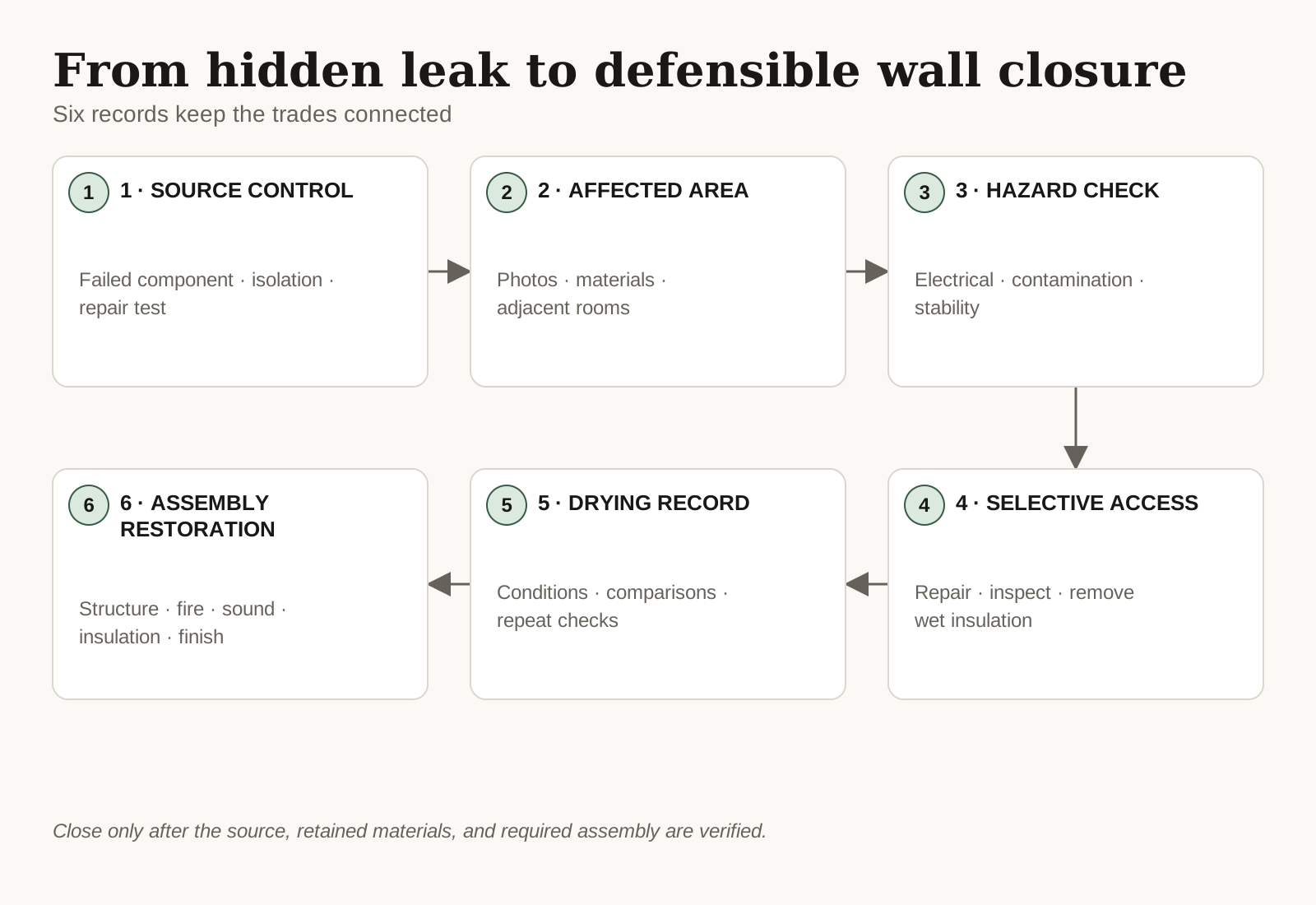
A good scope follows an evidence chain. It records what failed, how flow was stopped, what materials became wet, which components were removed, how retained materials were dried and checked, and how the original assembly will be rebuilt. If one link is missing, a polished finish can hide an unresolved problem.
- Source record: failed fitting, pipe, fixture, appliance, or exterior transition; photographs; isolation; repair; and a post-repair test.
- Water and material record: whether the source was reasonably classified, first-discovery timing, affected surfaces, concealed insulation, flooring, cabinetry, and adjacent rooms.
- Electrical record: components exposed, circuit status, qualified evaluation, and replacement or reconditioning decision.
- Selective-opening plan: access needed for repair, drying, cleaning, inspection, and reconstruction, including hazardous-material review where the age and scope warrant it.
- Drying record: equipment, environmental conditions, repeat observations, comparisons with known-dry materials, and the professional's stated completion criteria.
- Assembly record: framing, shear, fire, sound, insulation, air, vapor, waterproofing, and finish duties that must be restored.
- Permit check: the jurisdiction, exact repair, concealed piping replacement, electrical work, structural work, and required inspections.
In San José, current Bulletin #201 lists drain, faucet, toilet, and leak repairs and stoppage clearing among plumbing-permit exemptions. It also says replacement of a concealed trap, drainpipe, or vent pipe is new work requiring a plumbing permit. The same bulletin exempts ordinary sheetrock and joint taping but says fire-rated sheetrock installations require a permit. These are scope-dependent local rules, not a Bay Area-wide answer.
How to compare estimates without buying only a patch
Do not compare only the square feet of drywall. One proposal may include leak access, wet-insulation removal, containment, repeat monitoring, electrical coordination, texture blending, trim, cabinet removal, and permit work. Another may include a patch and one coat of paint. Put both into the same work-breakdown list before comparing price.
Ask who owns each transition. Who confirms the leak is stopped? Who decides the cavity can close? Who documents electrical disposition? Who protects floors and cabinets? Who restores insulation and rated layers? Who matches texture and paints to a natural break? Who schedules inspection when required? A complete answer is more valuable than a low total with undefined exclusions.
No universal cost or duration belongs in this article. Access, source type, contamination, affected materials, occupied-space protection, drying conditions, cabinetry, tile, structural duties, permits, and finish matching all change the scope. A responsible estimate should state those assumptions beside its number.
What not to do
- Do not keep using the suspected fixture to see whether the stain grows.
- Do not assume water directly behind the paint is the source.
- Do not touch wet switches, outlets, lights, appliances, or an electrical panel.
- Do not puncture a bulging surface while standing below or beside it.
- Do not aim fans into a cavity until the water source and contamination concern are understood.
- Do not paint over a stain before the source and retained materials are verified.
- Do not accept “dry” from one unexplained meter number. Instrument type, material, calibration, dry-area comparison, and repeat readings matter.
- Do not assume an emergency repair settles permit, drying, electrical, reconstruction, or insurance questions.
Questions homeowners ask after finding a wall leak
Can I leave the wall closed if the stain stops growing?
Not from that observation alone. The valve may have stopped new water while insulation, the back of the drywall, framing, or flooring remains wet. The source repair and cavity condition need separate verification.
Should I call insurance before a contractor?
Policy duties and coverage are contract-specific. Preserve photographs, take reasonable safe steps to limit additional damage, and contact the insurer promptly if you may make a claim. Do not let the coverage conversation delay emergency source control or life-safety action.
Does a plumber repair the drywall too?
Some plumbing companies offer limited access patching, while others stop after the pipe repair. Ask in writing. A finish patch may still require drying verification, insulation replacement, texture blending, paint, rated-assembly restoration, or a general contractor.
Can a thermal camera find the leak without opening the wall?
It can show surface-temperature patterns that support an investigation, but it does not see through the wall or identify water by itself. Air movement, insulation gaps, sunlight, and temperature differences can produce patterns. Correlate it with moisture observations and controlled source testing.
Is the 24–48-hour EPA target a guarantee?
No. It is prompt-response guidance intended to reduce mold risk. EPA expressly notes that mold may occur within 48 hours and may not occur after 48 hours. The material, water source, cavity, environment, and observed conditions still control the decision.
Sources and verification
Primary and standards-organization sources opened and checked August 9, 2026:
- U.S. EPA: The Key to Mold Control Is Moisture Control
- U.S. EPA: Water Damage Cleanup and Mold Prevention, Table 1
- U.S. EPA WaterSense: Leak Detection and Flow Monitoring Devices
- U.S. EPA: Flood Cleanup to Protect Indoor Air and Your Health
- Electrical Safety Foundation International: Water-Damaged Electrical Equipment
- Teledyne FLIR: Detecting Water Leaks With Thermal Imaging
- Teledyne FLIR: Pin and Pinless Moisture-Meter Limits
- California Department of Insurance: Residential Property Claims Guide
- City of San José Bulletin #201: When Is a Building Permit Required?
- City of San José: Plumbing Projects, updated April 9, 2026
The Electrical Safety Foundation International is a standards-aligned safety nonprofit rather than a government agency. It is used only for electrical equipment disposition; local authorities and qualified electricians control real work.
Scope: General educational information, not an emergency-response plan, leak diagnosis, environmental clearance, structural opinion, electrical authorization, insurance interpretation, or permit determination. Conditions inside a wall cannot be verified remotely. Keep away from water, unstable finishes, and electrical hazards, and use qualified local professionals.