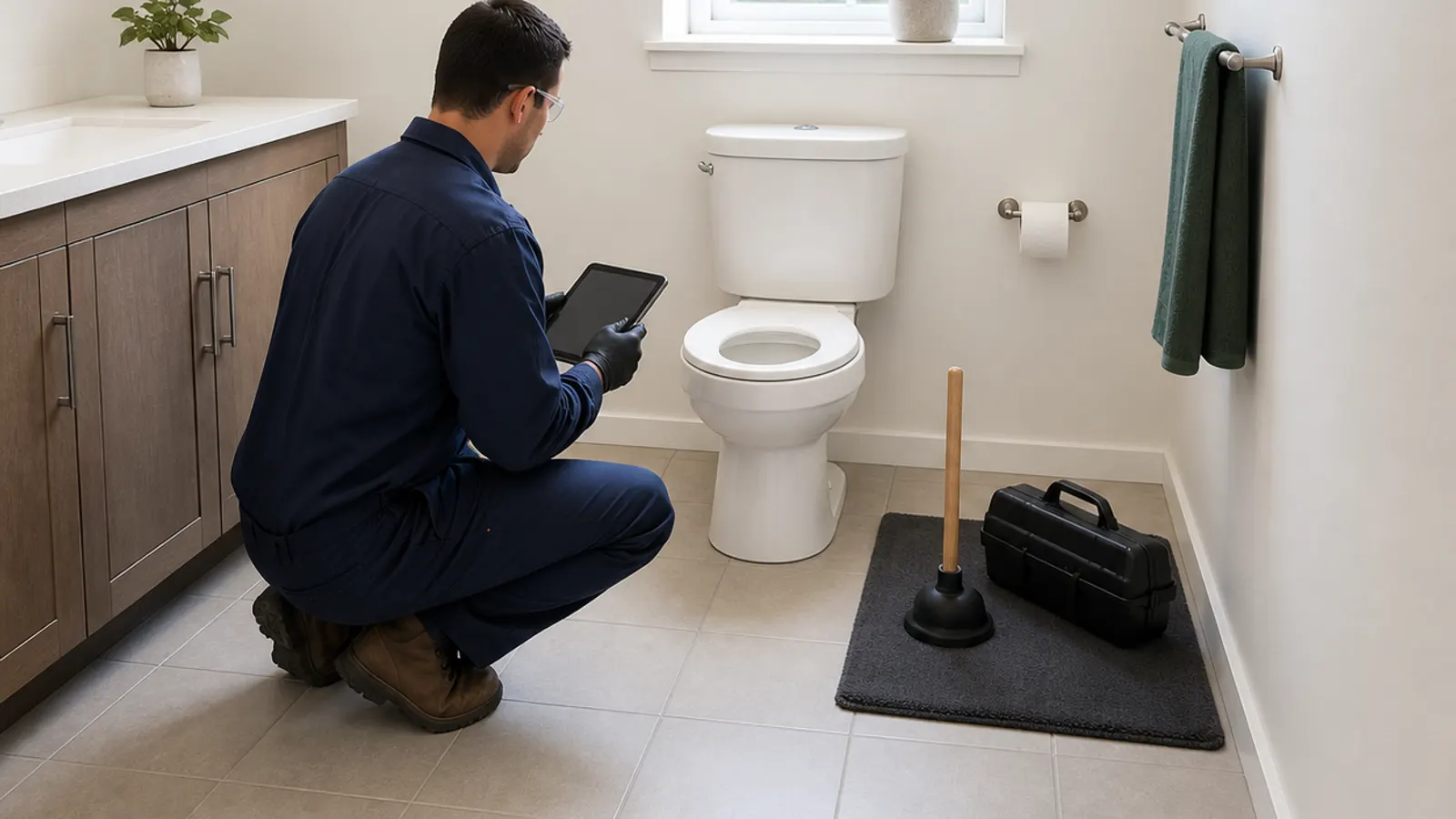
Sources and San José rules checked August 9, 2026. Symptom patterns change the probability of each zone; they do not locate a blockage with certainty.
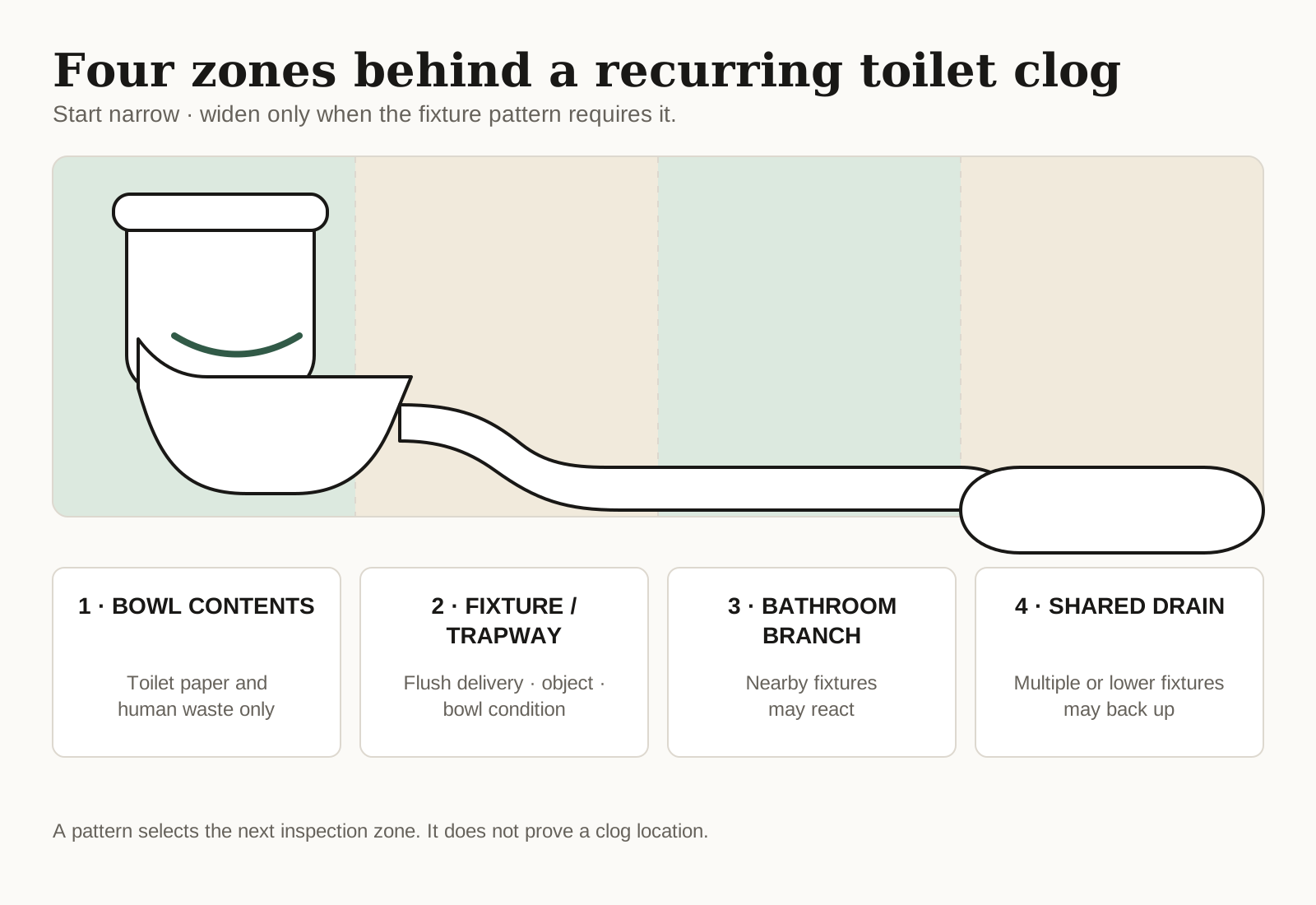
| Pattern | Start by checking | What it does not prove |
|---|---|---|
| Same toilet clogs; other fixtures drain normally | Fixture zone Bowl contents, trapway object, tank operation, bowl refill, jets, and exact model instructions | It does not prove the toilet must be replaced. |
| Flush looks weak or incomplete, without other drain symptoms | Flush delivery Correct tank setup, water level, flapper or valve action, rim or siphon path, and manufacturer maintenance | It does not prove low-flow design is the cause. |
| Plunging restores flow, but the same toilet clogs again | Partial obstruction Toilet trapway or nearby branch; record what enters and how long clearing lasts | A temporary opening does not prove full removal. |
| Nearby tub or sink gurgles when toilet flushes | Shared branch or vent Connection layout, vent protection, branch condition, and downstream restriction | Gurgling alone does not prove the vent or main sewer is blocked. |
| Multiple fixtures are slow or wastewater rises at a lower drain | Downstream system Shared branch, building sewer or lateral, septic system, roots, damage, or public-main condition | The pattern does not prove who owns the blockage or its exact location. |
What to do after the toilet clears again
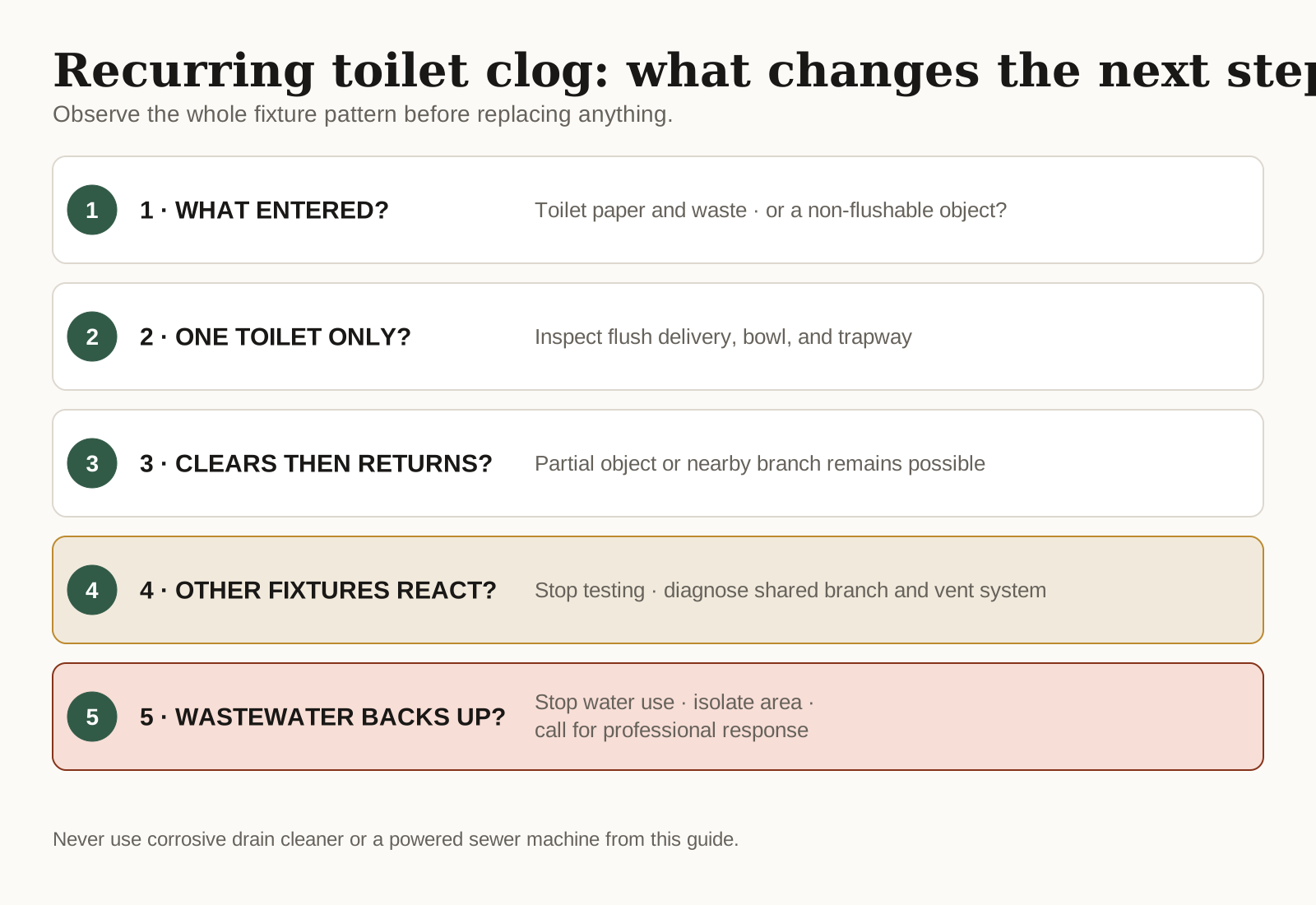
A recurring clog is easiest to diagnose between events, when the floor is dry and the fixture is usable. Do not wait for the next overflow without creating a record. The useful questions are what entered, how the flush looked, which other fixtures reacted, and how long the clearing lasted.
- Limit what is flushed. EPA advises flushing toilet paper, not wipes or other non-flushable items. Keep a waste container in the bathroom so the alternative is easy.
- Record the event. Note the toilet, date, bowl contents, paper amount, water rise, flush sound, tool used, material retrieved, and whether a nearby fixture moved or gurgled.
- Observe one normal flush. With no blockage or chemical present, compare handle or button action, tank release, bowl movement, and refill to the manufacturer's instructions. Do not repeatedly stress a marginal branch.
- Check the rest of the bathroom. Observe whether the sink, tub, or shower is slow. Ask whether laundry or another bathroom has shown a pattern. Do not run multiple fixtures just to provoke a backup.
- Choose the next diagnostic zone. One-toilet-only symptoms begin at the fixture. Multi-fixture or lower-drain backup begins downstream and warrants prompt professional assessment.
Build a record that separates a fixture problem from a drain problem
A useful record is short and consistent. Give each event one line: date, toilet location, what was flushed, whether the bowl rose or drained slowly, whether a tool restored flow, and which other fixtures showed a change. Photograph the fixture model information and any water at the base, but do not photograph or handle sewage to improve the record. If a plumber retrieves an object, ask for a plain description and where it was found. If a camera is used, retain the full report and video rather than relying on one still image.
Context matters. Note whether the event followed laundry, a shower, heavy building use, a recent fixture installation, drain work, excavation, or a long period with no symptoms. These observations do not prove causation. They help the responder decide whether to start at the bowl, remove the toilet, use an approved cleanout, evaluate a branch, or coordinate with the sewer or septic service.
For a rental or multi-unit building, notify the property manager before opening shared piping or authorizing reconstruction. Identify the unit and exact fixtures affected without assuming that the restriction is inside another tenant's space. A shared-stack or building-drain investigation needs controlled access and communication so that another occupant does not add water during diagnosis. If wastewater is already escaping, the immediate goal is isolation and professional response, not a more complete homeowner test.
When the toilet itself is the leading suspect
A toilet contains an internal trapway that carries waste from the bowl to the floor connection. A foreign object can lodge there while allowing water to pass. A hand plunger may open the path temporarily without retrieving the object. A toilet auger designed for the fixture may be appropriate when used under its exact instructions, but stop if the cable kinks, the bowl could be damaged, chemicals are present, or the operator cannot control the tool.
What enters the bowl
EPA says wipes and other non-flushable products can damage internal plumbing, sewer systems, and septic systems. Its current sanitary-sewer-overflow page lists products marked “flushable” among materials that may create blockages. A package label is therefore not evidence that a particular wipe will pass through an existing fixture and drain system.
What the tank delivers
For a tank toilet, a flush depends on the parts operating as the model was designed. An incorrect water level, shortened valve action, incompatible replacement part, loose chain, or other maintenance condition can reduce the intended flush. EPA WaterSense tells homeowners to investigate toilets that will not flush or have other problems and to contact a plumber when appropriate. Use the fixture manual rather than changing water level or parts by guess.
What the bowl and trapway can pass
Mineral accumulation, a foreign object, physical damage, and the geometry of a particular older fixture can affect performance. Document the make and model before replacing it. A plumber can compare normal fixture operation, use an appropriate toilet tool, or temporarily remove the toilet when evidence supports that step. Removal also creates a seal and flange inspection task, not just an opportunity to push a cable through the opening.
“Low-flow toilet” is not a complete diagnosis
Older first-generation fixtures can have performance histories worth considering, but water efficiency by itself does not prove why a current toilet clogs. EPA states that WaterSense-labeled tank toilets are independently certified for efficiency and performance. The performance criteria include mixed-media flushability, bowl cleaning, drainline transport, and waste extraction.
As of the research date, EPA says WaterSense Version 1.2 remains in effect while Version 2.0's effective date is paused. That dated detail belongs in product selection, not in an assumption that every labeled toilet fits every bathroom. Rough-in, bowl shape, height, seat, accessibility needs, supply condition, shutoff, flange, branch layout, and installation all matter.
Before replacing a toilet to solve clogs, verify whether the present fixture receives and releases the flush intended by its manufacturer and whether the drain accepts flow normally. A new fixture will not remove roots, repair a damaged branch, correct improper slope, or clear an object farther downstream.
Signs the problem may be beyond the fixture
A bathroom branch receives more than one fixture. If flushing the toilet changes a tub or sink, air and wastewater are interacting in the shared system. Plumbing vents protect trap seals and support drainage, but a gurgle is not a remote vent diagnosis. A partial branch restriction, downstream backup, configuration issue, or other condition may produce similar noise.
Water rising from a tub, shower, or floor drain is more urgent because the system is no longer carrying wastewater away from the lower opening. Stop water use rather than testing again. EPA states that sanitary sewer overflows contain untreated or partially treated sewage and can carry pathogens. Avoid contact and use an appropriate professional cleanup plan after source control.
Roots can enter through defects in a sewer line, and San José identifies roots and inappropriate materials as blockage sources. Pipe damage, offsets, bellies, scale, recent construction debris, and septic conditions can also enter a site-specific investigation. A camera may help after the line is made passable, but its visibility and access have limits; it does not guarantee every connection or defect has been seen.
Public sewer, private lateral, or septic system?
The responder also needs to know where the building sends wastewater. On a public sewer, the toilet connects through private interior piping and a private lateral before the public system. San José tells property owners that they are responsible for keeping their lateral flowing; the live City page and the property's actual connection details should guide any boundary question. Do not assume the City owns a blockage simply because symptoms affect more than one fixture.
A septic property adds a tank, treatment condition, and soil-dispersal system to the investigation. A full or impaired septic system can create downstream symptoms that look similar to a building-drain restriction. A plumber may still need to rule out the fixture and building piping, while a qualified septic provider assesses the onsite system. The article does not infer which one is responsible from a gurgle or slow toilet.
Ask the responder to label findings by location and confidence: what was directly seen, what was inferred from flow, what access was used, what could not be inspected, and what test comes next. “Line opened” is different from “cause removed,” and “camera passed this section” is different from “the complete system is defect-free.” Those distinctions keep a temporary clearing from becoming an unsupported repair or replacement decision.
A safe tool boundary
Flange-style toilet plunger
A toilet plunger is designed to seal at the bowl outlet. Use controlled motion and stop if the bowl approaches overflow, the seal will not hold, the fixture moves, the floor leaks, or chemicals are present. Repeated force after every clog can mask a partial object without resolving it.
Hand toilet auger
A toilet auger is different from a general sink cable. RIDGID's current K-3 page identifies its product as a manual toilet-and-urinal auger and says its vinyl guard helps protect porcelain from accidental scratching. That describes one product, not a universal operating method. Follow the exact tool instructions and stop when the tool, fixture, exposure conditions, or operator control are uncertain. Powered sewer-machine work is excluded.
Toilet removal
Removal is a plumber-level decision when an object cannot be retrieved, the trapway needs inspection, the seal or flange may be involved, or downstream access is required. The toilet must be safely handled, the flange and floor assessed, a correct new seal installed, and the connection tested. A rocking fixture or wet floor should not be repeatedly tightened by guess.
Repair the toilet, replace it, or inspect the drain?
| Evidence | Leading path | Confirm before authorizing |
|---|---|---|
| Incorrect or failed replaceable tank component; branch accepts flow | Fixture maintenance | Exact compatible part, manufacturer setup, leak test, and normal flush observation |
| Object lodged in trapway; fixture otherwise serviceable | Professional retrieval or fixture removal | Bowl condition, retrieval risk, seal and flange scope |
| Damaged bowl/trapway, chronic model-specific performance after correct setup, or replacement desired | Fixture replacement | WaterSense listing if desired, rough-in, height, footprint, supply, shutoff, flange, clearances, and floor finish |
| Other fixtures react, lower drain backs up, or same problem survives fixture work | Branch/sewer diagnosis | Appropriate cleanout, line clearing, camera limitations, pipe condition, ownership, septic/public system, and repair access |
San José Bulletin #201 lists toilet repair, stoppage clearing, and minor parts replacement among plumbing-permit exemptions. It states that necessary replacement of a concealed trap, drainpipe, or vent pipe is new work requiring a plumbing permit. A broader bathroom remodel, relocated fixture, new piping, floor repair, accessibility change, or structural work may create additional requirements.
Recurring toilet questions
Why does plunging work only for a few days?
It may create a temporary path through a partial object or downstream restriction without retrieving or removing the cause. Record how long flow lasts and whether other fixtures react, then have the fixture and branch diagnosed.
Can “flushable” wipes clog a toilet?
EPA's current sewer-overflow page lists some household products marked flushable among materials that may create blockages. EPA separately urges people to flush only toilet paper. Put wipes in the trash.
Does gurgling mean the roof vent is blocked?
Not by itself. Gurgling shows an air-and-flow interaction. A partial branch blockage, shared downstream condition, vent problem, or configuration issue may be involved. A plumber should inspect the system rather than treat the sound as proof.
Will a new toilet fix the clog?
Only if the fixture is the actual limiting condition and the downstream drain accepts flow. A new toilet does not correct roots, damaged pipe, poor configuration, septic trouble, or a shared obstruction.
Should I use drain cleaner in a toilet?
This guide does not recommend it. Corrosive cleaner can create splash exposure for plunging, augering, or removal and may conflict with fixture or product instructions. Tell the plumber if any cleaner is present and contact Poison Control for exposure.
Sources and verification
Primary, local-government, manufacturer, and poison-center sources opened and checked August 9, 2026:
- U.S. EPA WaterSense: Home Maintenance, toilet section
- U.S. EPA WaterSense: Residential Toilets, updated May 29, 2026
- U.S. EPA: Only Flush Toilet Paper
- U.S. EPA: Sanitary Sewer Overflow Frequently Asked Questions
- City of San José: Sewer Backup Prevention and Backwater Valves
- City of San José Bulletin #201: permit requirements and exemptions
- National Capital Poison Center: drain-cleaner burn and splash risk
- RIDGID: K-3 manual toilet-auger product page
The RIDGID page supports only the stated K-3 product characteristics; the exact manual for the tool actually used controls. Poison Control supplies exposure guidance, not a clog diagnosis.
Scope: General education, not a sewer-location diagnosis, sewage cleanup protocol, fixture manual, permit decision, or guarantee. Avoid wastewater contact, corrosive cleaner, and powered drain machines. Stop water use for multi-fixture or lower-drain backup and use qualified local professionals.