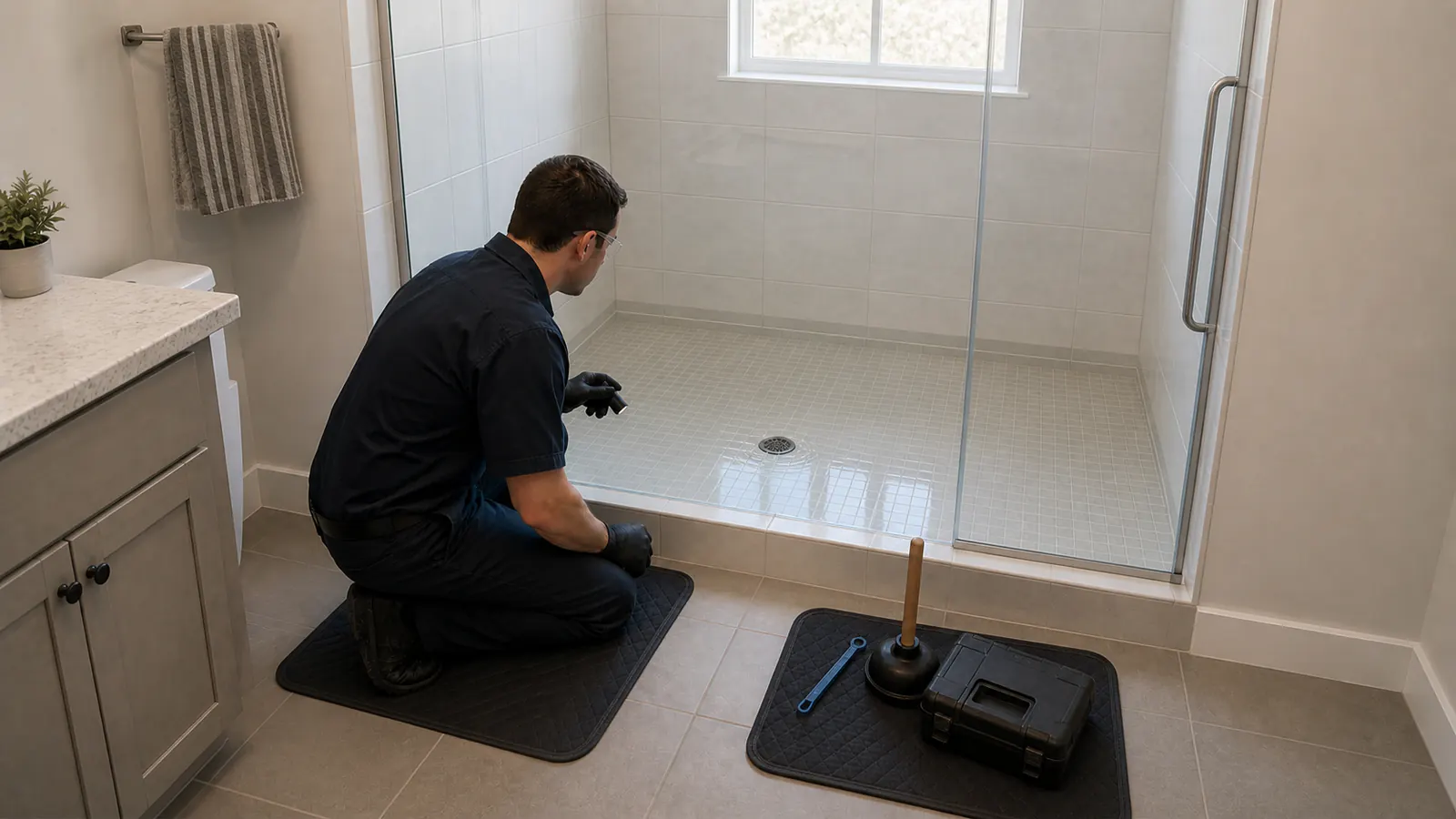
Sources and San José rules checked August 9, 2026. A symptom narrows the likely zone; it does not prove the material or exact blockage location.
| What you see | First interpretation | Next step |
|---|---|---|
| Water visible only below the grate while the shower floor is dry | May be normal A fixture trap intentionally holds a water seal | Judge actual floor drainage; do not call the water below the grate a clog by itself |
| Clear water pools during a shower and slowly leaves | Restricted flow Opening, trap, or branch may not carry the present flow | Stop adding water; check chemical history and visible hair |
| Shower is slow but sink and toilet behave normally | Fixture zone first Local hair mat or near-fixture restriction is more plausible | Use the low-risk sequence once; record whether the result lasts |
| Shower changes when a toilet, sink, or washer drains | Shared system Branch, building drain, vent interaction, or sewer/septic condition may be involved | Stop testing and call for professional diagnosis; pattern is not main-line proof |
| Water reaches outside the shower or a ceiling below becomes wet | Leak boundary Drainage and waterproofing or connection questions now overlap | Stop shower use, protect the area below, and diagnose before finish repair |
First decide where the standing water is
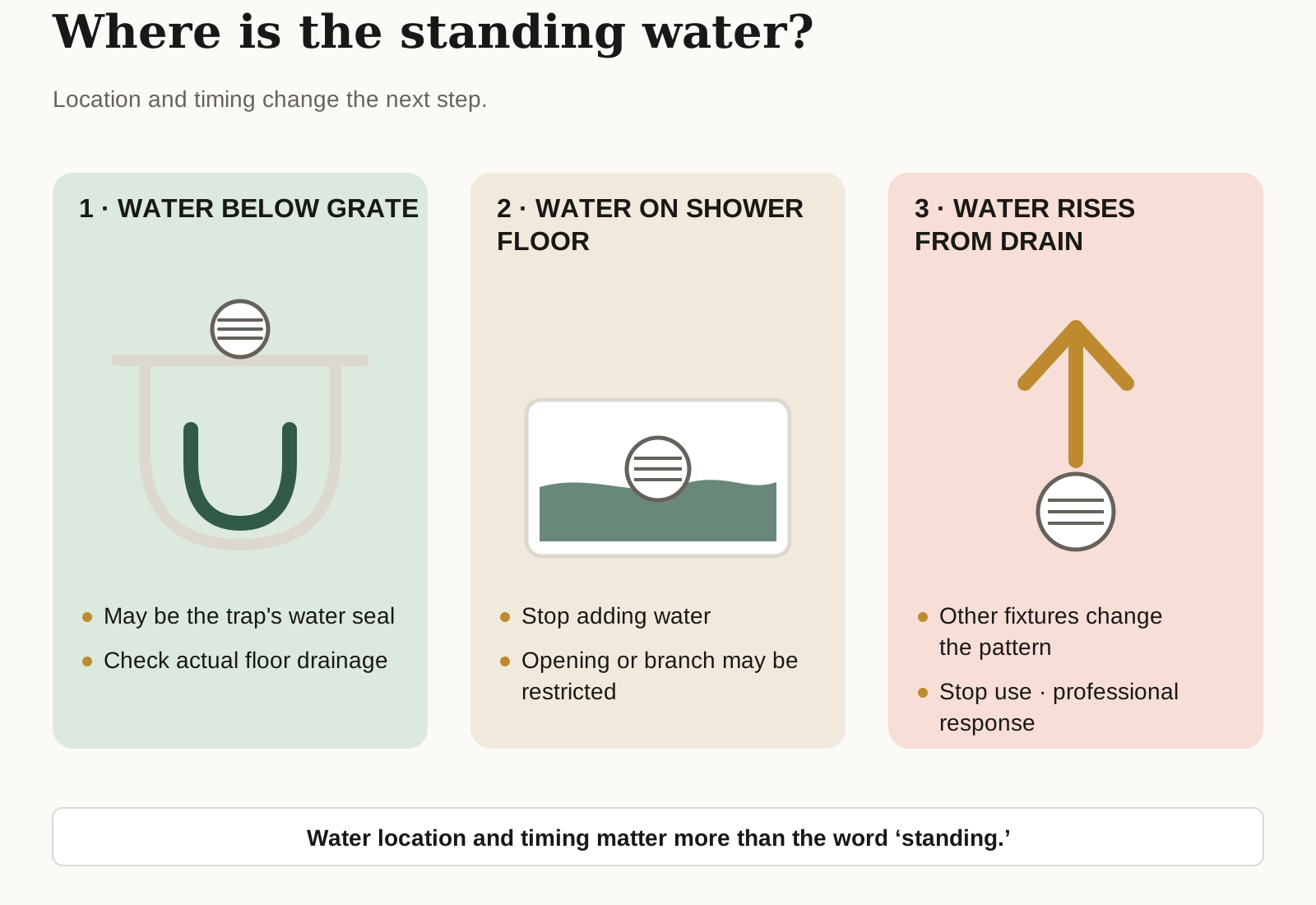
Looking down a shower drain and seeing water does not always mean the line is blocked. San José's current plumbing page says each fixture trap creates a water seal that helps prevent sewer gas from entering the home. That water sits below the drain opening. If the shower floor is dry and a normal shower drains without pooling, visible water lower in the pipe may simply be the trap seal.
Water covering the shower floor is different. The shower is delivering water faster than the drain is carrying it away. That could begin at the grate, in the near-fixture trap area, or farther into the bathroom branch. Stop the shower before water crosses a curb or threshold. Do not keep running it to measure how deep the pool becomes.
Water that rises when the shower is off changes the response again. Ask what other fixture was used just before the movement. A nearby toilet or sink reaction raises concern for shared piping. Laundry or fixtures elsewhere can point to a wider branch, building drain, sewer lateral, or onsite septic condition. This pattern changes where a plumber starts; it does not identify one exact pipe from the bathroom.
The lowest-risk sequence for one slow shower
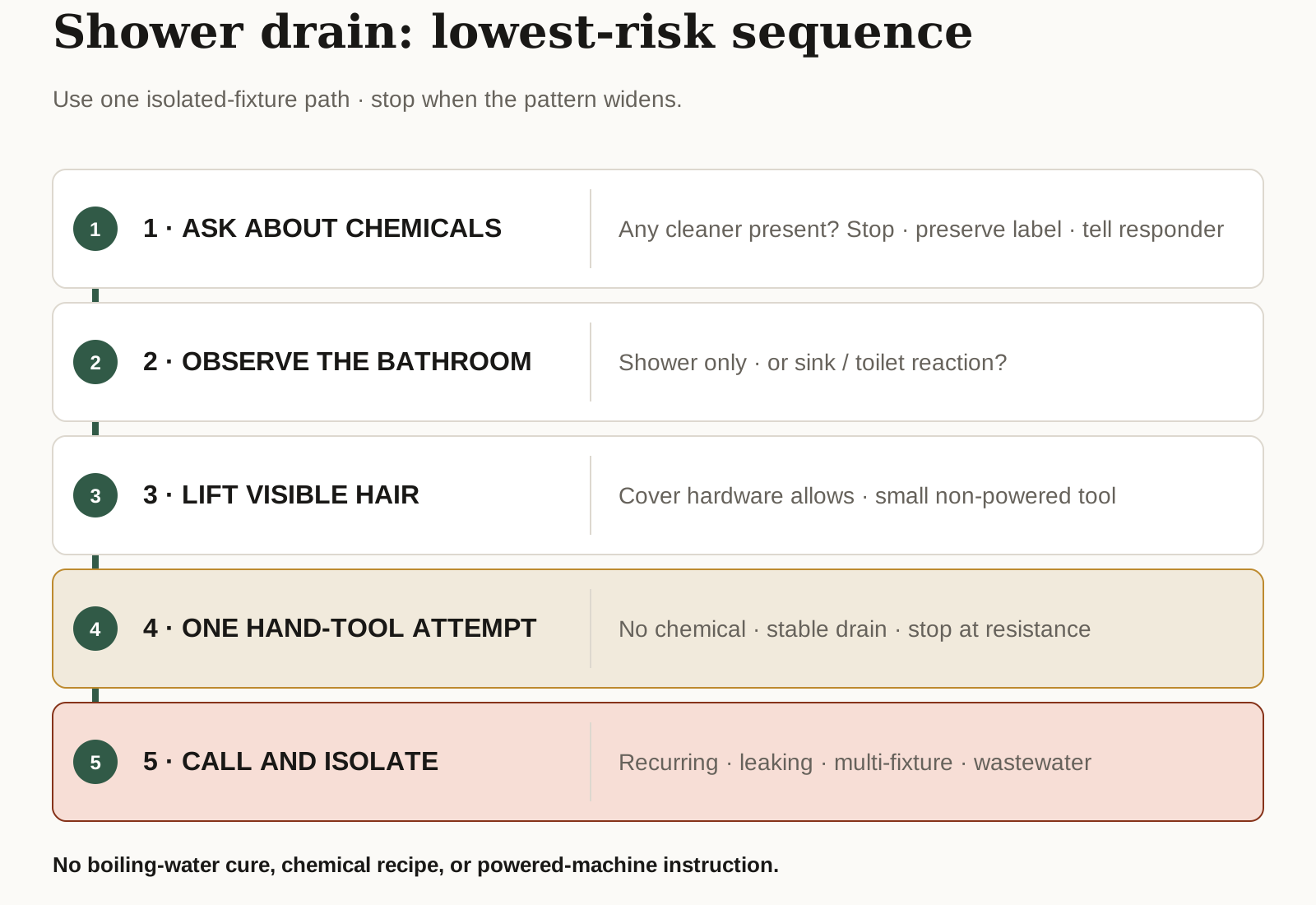
- Stop adding water. Let clear shower water recede if it can. If it does not recede, if the water is contaminated, or if another fixture affects the shower, skip homeowner steps.
- Ask what has already been poured in. If any drain cleaner or unknown product is present, do not plunge, open the drain, or insert a tool. Preserve the container information and tell the responder.
- Observe the whole bathroom. Note the sink and toilet behavior without running multiple fixtures to provoke a backup. Ask whether the clog followed another plumbing event.
- Inspect the grate and visible opening. Use good light. Remove only a cover designed for ordinary access, following its hardware or manufacturer instructions. Do not pry against tile, a bonded drain, or waterproofing.
- Lift visible hair outward. With gloves and no chemical present, use a small non-powered hair tool intended for that opening. Pull material toward you; do not use a sharpened wire or force debris deeper.
- Make one controlled hand-tool decision. A cup plunger or hand-operated drain tool may suit an isolated shower when its instructions, drain design, and condition allow. Stop at hard resistance, kinking, loss of control, movement of the drain, or leakage.
- Record the result. Note what came out, whether the floor drained normally, whether another fixture reacted, and whether the slowdown returns. A temporary opening is not proof that the full restriction is gone.
EPA's household hazardous-waste page lists a plunger or plumber's snake as alternatives to drain cleaner. That is a product-reduction suggestion, not a universal instruction for every shower. Cover design, trap access, piping, prior chemicals, waterproofing, and operator control decide whether either tool is suitable.
This shower-specific path should not be borrowed for a toilet, disposal, kitchen sink, floor drain, or cleanout. Those openings, traps, appliances, and contamination risks differ. A tool sold as a generic “snake” does not make the access safe. If the fixture type or cover is uncertain, stop before tool use and ask the responder to identify the approved access. That boundary keeps a one-shower guide from turning into a whole-house or main-sewer diagnosis.
Visible hair is evidence; “hair clog” is still a hypothesis
Hair wrapped around a grate or retrieved from the opening is direct evidence at that point. It does not show what remains past the bend. Soap and personal-care residue can hold hair together, while construction debris, a foreign object, pipe condition, branch configuration, or a downstream restriction may produce the same slow-floor symptom. Describe what was retrieved rather than naming everything deeper as hair.
A short plastic hair-retrieval tool can be appropriate when the cover permits access and the tool is made for that drain. Follow its instructions and account for the entire tool when it comes back out. Stop if it will not turn or withdraw freely, catches on a fixed part, begins to break, or would require dismantling the drain body. Do not improvise with a metal coat hanger or cut plastic that can leave sharp edges or lost pieces.
A hand-operated cable reaches differently from a surface hair tool. Use only an access point and tool intended for the drain, keep continuous control, and respect the tool's stop conditions. This article gives no cable diameter, reach, rotation technique, or powered-machine instructions because those choices depend on the piping and equipment. A powered sewer machine, improvised drill attachment, or high-pressure device belongs outside this homeowner guide.
If a drain chemical is present, the tool sequence stops
Poison Control says many non-enzymatic drain cleaners contain concentrated corrosive acids or bases. They can cause burns, and splashback can occur from a blocked drain. Standing water hides where the product is and increases uncertainty for anyone who later removes a cover, plunges, or uses a cable.
Do not add a second product, bleach, vinegar, baking soda, or anything else. EPA's household-hazardous-waste guidance says never mix hazardous household products because incompatible materials can react, ignite, or explode. Keep the original label available and tell the plumber exactly what was used, how much if known, and when. Do not neutralize it by guess.
Poison Control also explains that baking soda and vinegar generally do not build useful pressure in a drain because it is not airtight and are unlikely to dissolve a tough oil or grease clog. A fizz is not proof that a restriction moved. For a skin, eye, inhalation, or swallowing exposure, use Poison Control's current online tool or call 1-800-222-1222 for immediate guidance.
When to stop and call
The shower is not the only fixture affected
Stop testing when flushing a toilet changes the shower, a sink gurgles with it, a lower drain rises, or multiple fixtures slow together. The pattern raises the likelihood of a shared branch or downstream condition. It does not prove that the public main is clogged. Interior piping, the private lateral, a vent interaction, septic trouble, or another configuration may still explain the symptoms.
Wastewater or unknown water rises from the drain
EPA says sanitary sewer overflows contain untreated or partially treated sewage and can carry pathogens. Keep people and pets away, stop water use, and use professional source control and cleanup. Do not run a tool through contaminated water from this guide. For a suspected public-system event, use the live City reporting route checked at the time because reporting contacts can change.
The drain, shower, or room below leaks
Water outside the shower is not proof that a clogged pipe caused the leak. Splash control, door or curtain conditions, grout and sealant transitions, drain connection, shower receptor or waterproofing, supply piping, and concealed drainage can require separate checks. Stop using the shower if a wall, baseboard, floor edge, or ceiling below becomes wet. Do not repair the visible drywall before the water source and affected assembly are understood.
The restriction returns or the tool meets a boundary
Call when visible hair removal does not restore normal drainage, a hand-tool result does not last, the tool meets hard resistance, the tool or cover cannot be recovered intact, the drain assembly moves, or safe access would require demolition. More force does not create better evidence. A plumber can choose an approved access, assess the branch, and document limits of clearing or camera work.
You rent, manage, or share the piping
Notify the property manager before dismantling a drain or opening shared piping. Record the unit, fixture, time, chemical history, and other-unit symptoms without assuming which tenant caused the condition. In an occupied building, the responder may need to control water use elsewhere before opening the system.
What a useful professional diagnosis should separate
The service request should distinguish drain clearing from repair. Ask the responder to identify the access used, the part of the system reached, what was directly retrieved or seen, what remains unverified, and whether normal flow was observed without leakage. “Opened the line” describes an outcome at that moment; it does not by itself identify the material, pipe condition, or expected life of the result.
If a camera is used, retain the full video and location notes. Water, debris, turns, branch connections, and access can limit what the camera shows. A clear view of one segment is not a guarantee for the whole system. If the property uses a septic system, tell the plumber and involve a qualified onsite-wastewater provider when symptoms or records point beyond the building drain.
San José's current plumbing page says a permit is required to add or replace plumbing systems or fixtures or modify piping configuration. Bulletin #201 lists clearing stoppages and minor drain repairs as exemptions, but says necessary replacement of a concealed trap, drainpipe, or vent pipe is new work requiring a plumbing permit. A shower drain, receptor, waterproofing, tile, framing, ceiling, accessibility, or commercial scope may involve other requirements. Confirm the actual work before authorizing demolition.
Prevent the next hair mat without promising a clog-proof drain
Use a removable hair catcher compatible with the exact drain and shower. It should not create a trip point, obstruct needed drainage, or interfere with the cover. Empty captured hair into the trash before it forms a dense mat. Clean only the accessible cover and catcher as their manufacturer allows.
Notice a change in drainage early. Record whether the floor begins pooling sooner, whether the slowdown returns soon after hair removal, and whether another fixture reacts. Those patterns are more useful than repeatedly pouring products into an unknown restriction. No catcher prevents every branch, vent, pipe, sewer, or septic problem.
Shower-drain questions
Is water visible down the shower drain normal?
It can be. San José explains that a fixture trap holds a water seal. If the shower floor stays dry and normal flow drains without pooling, water below the grate may be that seal. Water on the floor or rising from the opening is a different condition.
Can I pull out visible hair myself?
When no chemical is present and the cover permits ordinary access, a small non-powered tool made for the opening can be a reasonable first step. Follow its instructions, pull outward, account for the whole tool, and stop at resistance or drain movement.
Should I pour boiling water down the shower?
This guide does not recommend a boiling-water cure. Pipe, joint, finish, and standing chemical conditions are not known, and heat does not establish what the restriction is. Use observation and an appropriate mechanical path instead.
Does a gurgling toilet mean the shower is on the main line?
It means the fixture pattern has widened. A shared bathroom branch, building drain, vent interaction, private lateral, public sewer, or septic condition may be involved. Stop testing and let a plumber locate the next appropriate access.
Why did the shower clog again after I pulled hair out?
More material may remain beyond the opening, the retrieved hair may have been only part of the restriction, or the real condition may be farther downstream. A recurring result needs diagnosis rather than a stronger version of the same attempt.
Sources and verification
Primary, poison-information, and local-government sources opened and checked August 9, 2026:
- City of San José: Plumbing Projects, updated April 9, 2026
- City of San José Bulletin #201: permit requirements and exemptions
- U.S. EPA: Household Hazardous Waste
- National Capital Poison Center: What's in drain cleaner?
- U.S. EPA: Sanitary Sewer Overflow Frequently Asked Questions, updated April 13, 2026
- City of San José: Sewer Backup Prevention and Backwater Valves, updated April 14, 2026
Scope: General education, not a blockage-location diagnosis, chemical-use instruction, sewage cleanup protocol, shower-waterproofing test, permit decision, or guarantee. Avoid chemical mixing, wastewater contact, improvised tools, and powered drain machines. Stop water use for multi-fixture, reverse-flow, or leakage symptoms and use qualified local professionals.