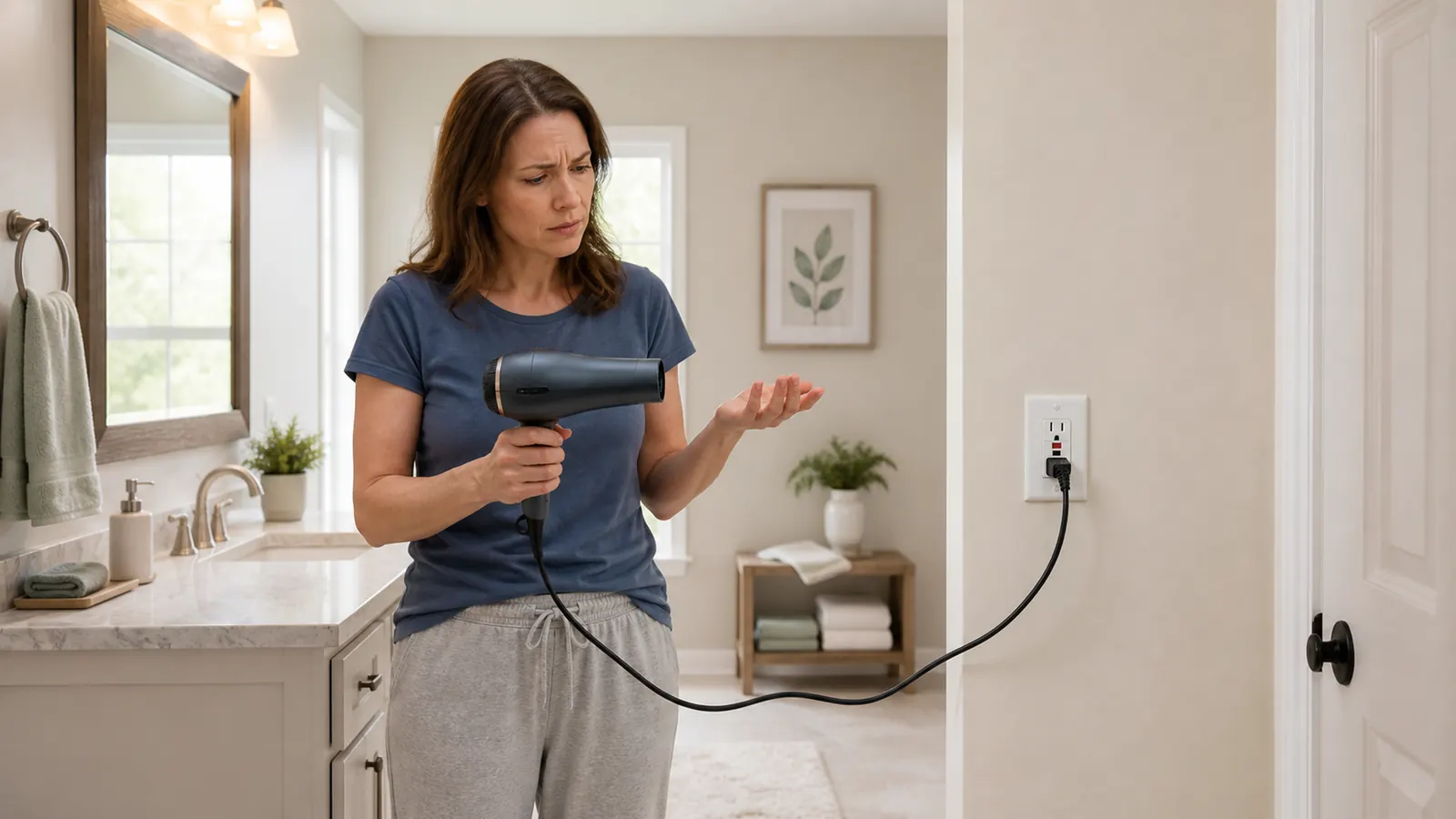
Why an outlet can be dead when the breaker looks normal
A circuit breaker is not an outage locator. A handle that appears to be in its usual position does not prove that power reaches this box, that the neutral path is intact, that a receptacle is serviceable, or that another protective device has not opened the circuit. The missing power may be local to the plugged-in item, limited to one half of a duplex receptacle, shared by several receptacles, or part of a wider branch-circuit problem.
An upstream GFCI is a common explanation. A GFCI receptacle can supply and protect other receptacles on its load side, and those receptacles can be in another room. Leviton’s currently posted model instructions illustrate that arrangement and also explain that a self-test GFCI may refuse to reset when it has no incoming power, is miswired, or cannot pass its internal test. Therefore, “the GFCI button will not stay in” is not a homeowner diagnosis and repeated pressing is not a repair.
A wall switch may intentionally control one receptacle or one half of it. The appliance, lamp, charger, or cord may have failed. A receptacle can wear internally. A connection at this box or an upstream box can be open, loose, or damaged. Moisture, pests, impact, or recent construction can affect the circuit. A breaker or another protective device may also require qualified evaluation even when its position does not explain the symptom. These are possibilities to separate through safe observation—not conclusions a homeowner should reach by pulling devices from boxes.
Red flags that end the homeowner check
The U.S. Consumer Product Safety Commission advises that an improperly operating outlet or switch can indicate an unsafe wiring condition. Its homeowner checklist says a warm outlet can indicate a loose connection and should not be used until checked by an electrician. It also identifies loose plug fit as an overheating and fire concern. That makes touch-free observation more important than getting the outlet working quickly.
- Heat or odor: A warm or hot plate, wall, plug, or cord; a sharp “electrical” or burning-plastic odor; or heat that returns after a load is removed.
- Visible damage: Brown or black marks, melting, cracking, a loose or missing plate, exposed parts, a plug that droops or does not seat firmly, or a device pushed into the wall.
- Sound or light: Buzzing, sizzling, crackling, popping, sparks, flashes, or intermittent operation when the plug or wall is not being touched.
- Shock: Any shock, tingle, or unexpected sensation from an appliance, plate, screw, sink, fixture, or nearby surface. Do not repeat the contact to confirm it.
- Water: A wet wall, recent leak, flooding, condensation at the device, outdoor water intrusion, or a receptacle exposed during cleanup. Electricity and water create shock and fire risks.
- Repeated protective action: A GFCI that immediately trips again, will not reset according to its label, shows a fault indication, or behaves differently after a recent electrical or water event.
Do not “see if it happens again” by plugging in a heater, microwave, refrigerator, disposal, vacuum, tool, or other substantial load. Do not keep resetting a protective device. Do not use an extension cord from another room as a permanent workaround, especially across doors, rugs, wet areas, or walking paths. If medical, safety, refrigeration, sump, communications, or other critical equipment lost power, follow that equipment’s emergency plan and get qualified help; do not depend on a trial reset.
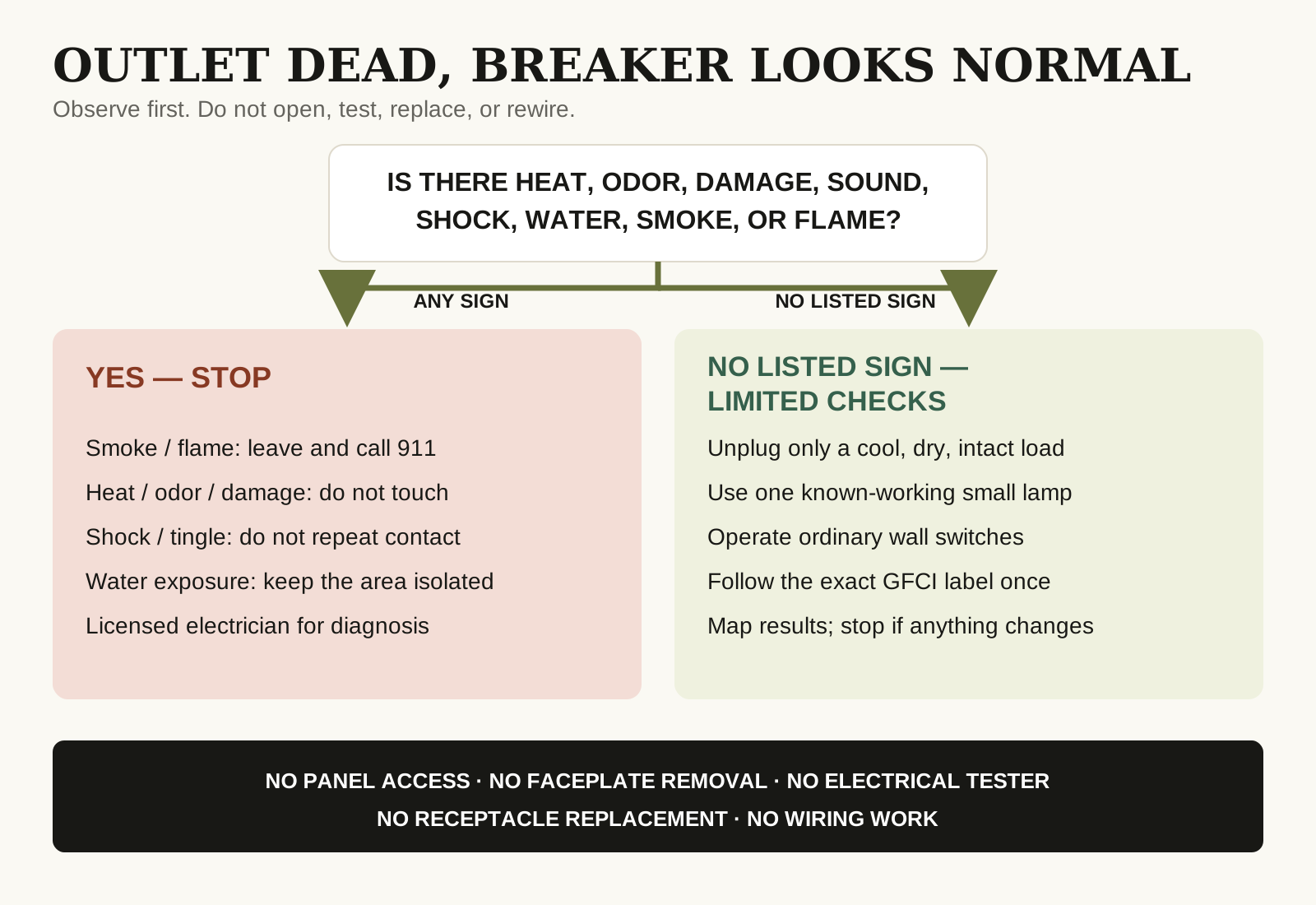
Safe checks when everything is cool, dry, and intact
These steps collect observations. They do not prove the outlet is safe, establish that conductors are de-energized, or repair a circuit. Stop if a smell, sound, heat, flicker, shock, water condition, or visible change appears at any point.
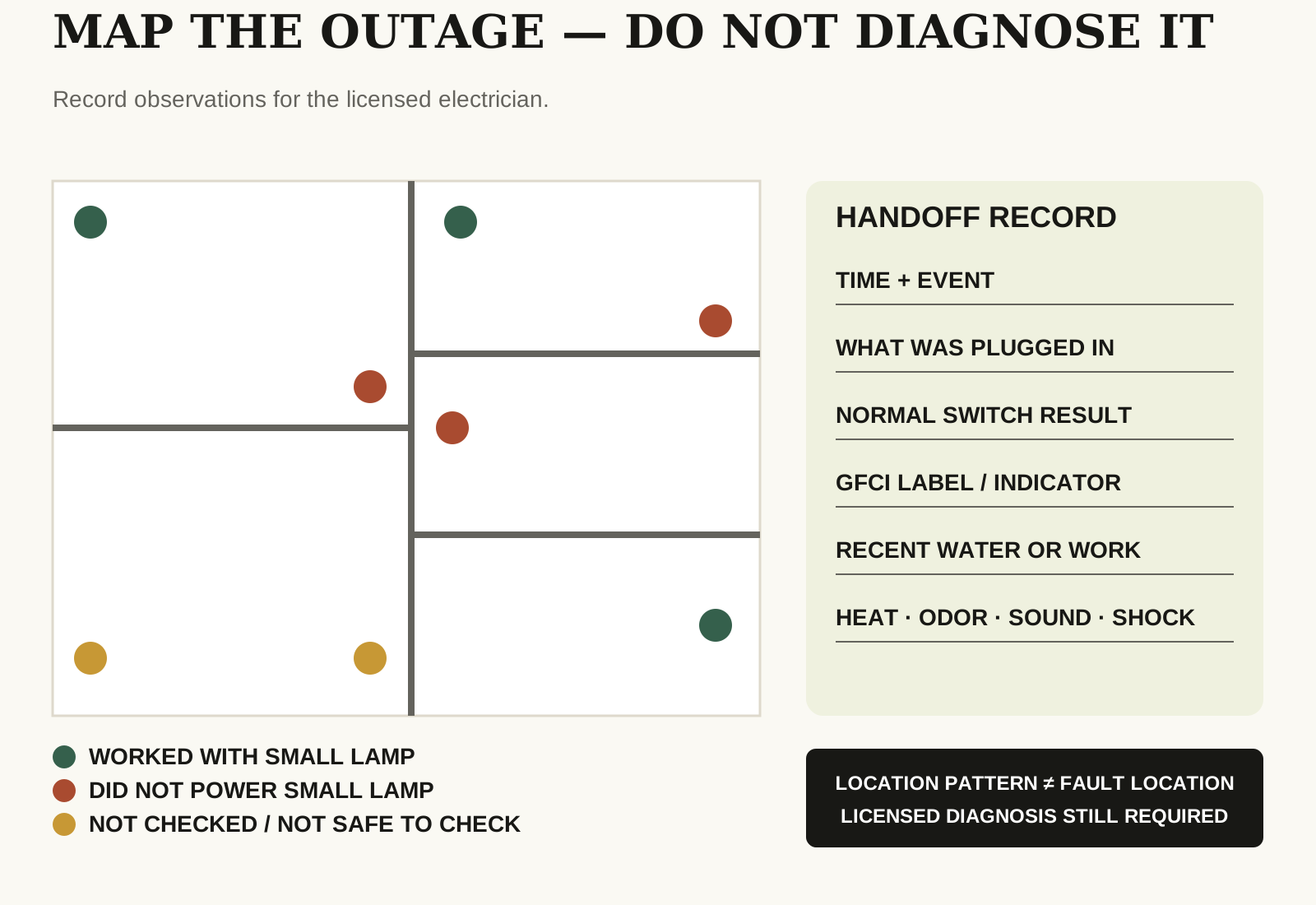
- Write down what stopped working. Record the room, receptacle position, time, what was plugged in, what else was operating, and whether the loss was sudden or intermittent. Photograph only intact finished surfaces from a safe distance. Do not remove a plate for a better picture.
- Separate the load from the outlet. Only if the plug, cord, receptacle, and surrounding area are cool, dry, intact, and silent, switch the appliance off and unplug it by the plug body—not by pulling the cord. Set aside anything with damaged insulation, bent or loose blades, odor, heat, or marks. Do not dismantle it.
- Use one known-working small lamp. Confirm a simple low-load lamp works at an ordinary known-working outlet, then use it to note which suspect receptacle positions do and do not power it. Keep the cord clear and hands dry. A lamp that turns on shows only that it operated in that moment; it is not an electrical safety test.
- Operate ordinary wall switches. With the original loads unplugged, move the room’s normal wall switches through their ordinary positions and note whether one controls the receptacle or half of it. Do not remove a switch plate, force a sticky switch, or keep using a switch that is warm, noisy, loose, damaged, or discolored.
- Look for accessible GFCI receptacles. Check finished, normally accessible locations that may protect the area, including kitchens, bathrooms, garages, laundry or utility areas, exterior locations, basements, and nearby rooms. Do not reach behind fixed appliances, enter water, use a ladder, or open an electrical panel to search.
- Follow the exact GFCI label once. Only for a dry, undamaged, cool, silent device, follow that manufacturer’s front-label or user instructions for TEST and RESET. Button travel and indicator behavior vary. If it will not reset, trips again, has no clear instructions, or shows an unfamiliar fault state, stop. Do not hold the button, tape it, bypass it, or try other electrical work.
CPSC’s checklist describes a monthly GFCI test with a lamp and the device’s TEST and RESET buttons. It also says a GFCI that does not perform correctly should be replaced. Replacement and the reason it failed to operate are licensed electrical work in this guide. The procedure above is deliberately narrower than installation instructions: it does not include breaker operation, conductor identification, voltage measurement, box access, or device removal.
What the outage pattern can—and cannot—suggest
| Observed pattern | Reasonable possibilities | What it does not prove |
|---|---|---|
| Only one appliance fails | Appliance, cord, plug, control, or compatibility issue | That the outlet is safe or the appliance is the only fault |
| One half of a duplex works | Intentional switched half, split arrangement, or local device/connection issue | That a switch is definitely the cause |
| One entire receptacle is dead | Local receptacle or connection; upstream protective device or connection | Where the open condition is located |
| Several nearby receptacles are dead | Shared branch-circuit path, upstream GFCI, upstream connection, or protective-equipment issue | That receptacles are “wired in series” or which box failed |
| Kitchen, bath, garage, exterior, or utility outlets are affected | GFCI protection or moisture exposure may be relevant | That reset is safe or that the visible GFCI controls them |
| Lights and receptacles in an area fail or vary | Wider branch-circuit, connection, switching, or supply issue | That a breaker replacement will solve it |
| Operation is intermittent, warm, noisy, or load-sensitive | Potentially unsafe device or connection condition | A safe opportunity to reproduce the symptom |
A home branch circuit supplies loads in parallel, but cables and connections may pass through multiple boxes. One upstream protective device or failed connection can therefore affect later locations. That is different from saying that household receptacles are wired in series. Room proximity is also imperfect: a GFCI and the receptacles it protects may be in different rooms.
Do not use a plug-in three-light tester, non-contact voltage pen, multimeter, continuity tester, or improvised device to turn this map into a diagnosis. Such tools have test limitations and require correct interpretation; a light pattern or lack of indication does not establish that conductors are safe to touch. A licensed electrician can select the test method, control the circuit, verify the instrument, and interpret results within the actual wiring arrangement.
What a licensed electrician should resolve
The electrician’s job is not merely to replace the receptacle that looks dead. The scope begins by confirming the reported pattern and identifying the circuit and protective devices under controlled conditions. It may include evaluation of the receptacle, upstream devices and connections, switching, branch conductors, neutral and grounding paths, GFCI or AFCI operation, breaker behavior, load, damage, and any effects from moisture or recent work. The test sequence depends on the wiring and must not be inferred from this article.
California’s March 2026 CSLB C-10 Electrical study guide describes the examination scope as evaluating existing systems, installing finish wiring, troubleshooting, locating and repairing inoperable wires and components, selecting and using test equipment, and following electrical safety practices. The guide is an exam outline, not a diagnosis for this home, but it supports the division of responsibility: circuit evaluation and repair belong in qualified electrical scope.
Ask the electrician to document the fault found, affected locations, repair, device ratings and compatibility, protective-device function, relevant code or permit path, and verification after work. If the fault is intermittent, the answer may require observation under safe controlled conditions or further investigation; it should not be converted into certainty because a new receptacle happened to work once.
When a general contractor belongs in the project
Many dead-outlet repairs stay entirely within electrical boxes and the electrician’s scope. General contracting becomes relevant when the qualified electrical plan requires selective access or restoration through drywall, plaster, cabinets, tile backing, flooring, fire-resistance assemblies, acoustic construction, or other finishes. The sequence should identify who makes the area electrically safe, who defines the access, what must remain visible for inspection, and who restores each layer.
Before cutting, check for plumbing, ducts, structure, environmental materials, and other concealed services. In older buildings, paint, plaster, texture, flooring, mastics, insulation, or other material may require lead or asbestos review before disturbance. A small electrical opening should not become uncontrolled demolition. Photograph concealed conditions only after the licensed electrician and other qualified specialists establish safe access.
If water contributed to the outage, identify and correct the source before closing the assembly. Plumbing, envelope, mechanical, and electrical roles may overlap, but the electrical components remain with the electrician. Any roof, roof-deck, flashing, penetration, or roof-leak evaluation and repair belongs to a qualified roofing contractor. Esquives does not offer roofing services. Interior patching should wait for the qualified source and drying plan.
Advice to ignore, even when it sounds efficient
- “Just flip every breaker off and on.” An unlabeled or shared panel, critical load, fault, damaged equipment, or unfamiliar protective device makes indiscriminate operation a poor diagnostic shortcut. This guide excludes panel access and breaker operation.
- “Pull the outlet and tighten the wires.” Removing a device exposes conductors and does not establish which parts are energized. Connection methods, damage, conductor material, box conditions, and protective requirements need qualified judgment.
- “A tester says it is dead, so it is safe.” Instruments and plug-in indicators have limitations. Correct selection, proving, contact, reference, and interpretation matter; one indication is not permission to touch wiring.
- “Replace the breaker because it did not trip.” The symptom does not prove breaker failure or select a replacement. Breaker compatibility, circuit conditions, load, protection, and panel work remain licensed scope.
- “Keep resetting the GFCI until it holds.” A refusal or immediate retrip is information to preserve. Manufacturer instructions explain that no incoming power or an internal-test problem can prevent reset; force and repetition do not identify the cause.
- “Move the load to an extension cord for now.” That may add trip, heat, overload, wet-location, door, and fire risks while hiding the original condition. Critical loads need an equipment-specific safe plan, not a casual cord route.
Dead-outlet questions homeowners ask
Can one GFCI make an outlet in another room stop working?
Yes. A GFCI receptacle may protect receptacles connected on its load side, and the manufacturer’s instructions note that those receptacles can be in different rooms. That possibility does not prove which GFCI controls your outlet or that resetting is safe when there is water, damage, heat, odor, sound, or shock.
Can only half of an outlet be controlled by a switch?
Yes, some installations intentionally switch one half. Operate only the normal room switches with suspect loads unplugged and everything cool, dry, and intact. If operation is intermittent, noisy, warm, loose, or damaged, stop rather than reproducing it.
Should I test the outlet with a phone charger?
A simple known-working low-load lamp gives an easier visible result and avoids making a valuable device part of the check. Even then, the result is only an outage-map observation, not a wiring or safety test.
Why will the GFCI not reset?
Depending on the device, it may lack incoming power, detect a problem, fail its self-test, be damaged, or have another condition. Follow the exact dry, intact device’s label once. Do not remove it, keep pressing, or infer the wiring fault.
Can Esquives replace the outlet?
Licensed electrical diagnosis and circuit repair belong to an electrical contractor. Esquives can coordinate general-construction access and finish restoration when the electrician’s documented repair requires it.
Sources and verification
Primary government and manufacturer sources opened and checked August 8, 2026:
- U.S. CPSC: Home Electrical Safety Checklist
- U.S. Fire Administration: Appliance and Electrical Fire Safety
- Leviton: Self-Test GFCI Receptacle Instructions
- California CSLB: C-10 Electrical Study Guide
The CPSC checklist is a July 2008 staff publication, and the posted Leviton instructions are model-specific. Their panel, installation, conductor, replacement, and repeated-operation steps are not reproduced here; the article uses only bounded consumer observations and clearly attributed GFCI behavior.
Scope: General education, not an electrical, fire, appliance, moisture, environmental, structural, roof, code, permit, or project diagnosis. Do not open panels or devices, use electrical testers, touch conductors, replace breakers or receptacles, or rewire from this guide. Electrical work requires a qualified licensed electrician. Roofing requires a qualified roofing contractor; Esquives does not offer roofing services.