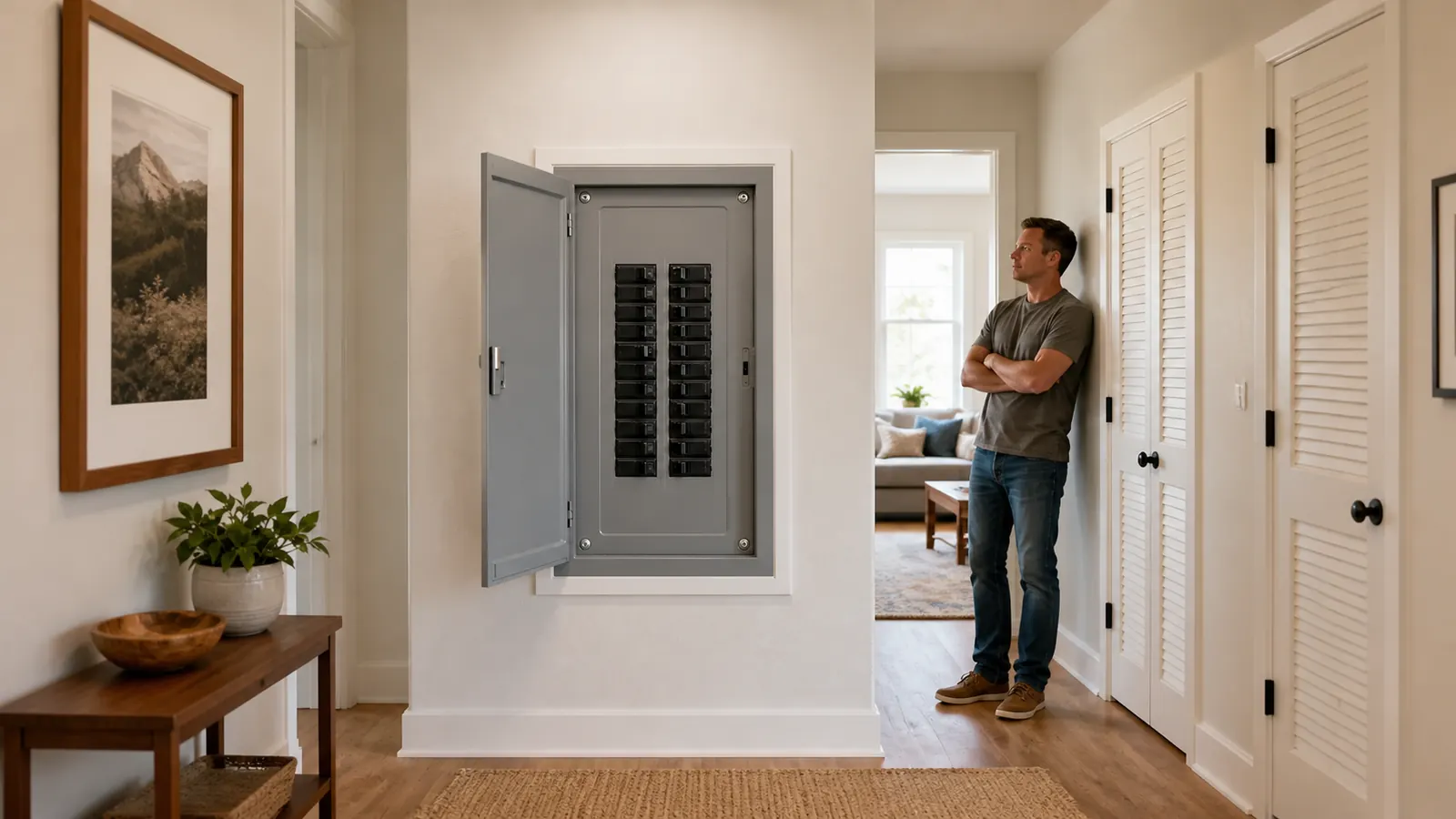
What a trip means—and what it does not
A trip means a protective device opened the circuit. Standard circuit breakers provide overcurrent protection associated with overload and short-circuit conditions. Other devices add functions: a GFCI monitors current taking an unintended path that can create shock risk; an AFCI looks for specified arcing patterns; a dual-function device combines arc-fault and ground-fault functions. Product families, trip indicators, and test procedures differ.
The trip is not proof that the breaker is defective, that the wiring is overloaded, or that one appliance is bad. It is also not proof that the protective device prevented every hazard. A loose or damaged connection can overheat without producing the same event as a large overcurrent, while an AFCI or GFCI can respond to patterns a standard breaker is not designed to detect. A licensed electrician must identify the exact protective device, preserve available trip information, and test the circuit and connected equipment under controlled conditions.
Currently posted Eaton residential product literature illustrates why the breaker type matters. Certain Eaton AFCI models store diagnostic histories for thermal/manual, arc, short-delay, overvoltage, ground-fault, or self-test categories. Schneider Electric’s June 2026 QO FAQ likewise distinguishes standard, GFCI, AFCI, and dual-function protection and says indicator diagnostics exist on some models. These manufacturer pages do not make all breakers interchangeable or turn a light into a homeowner diagnosis.
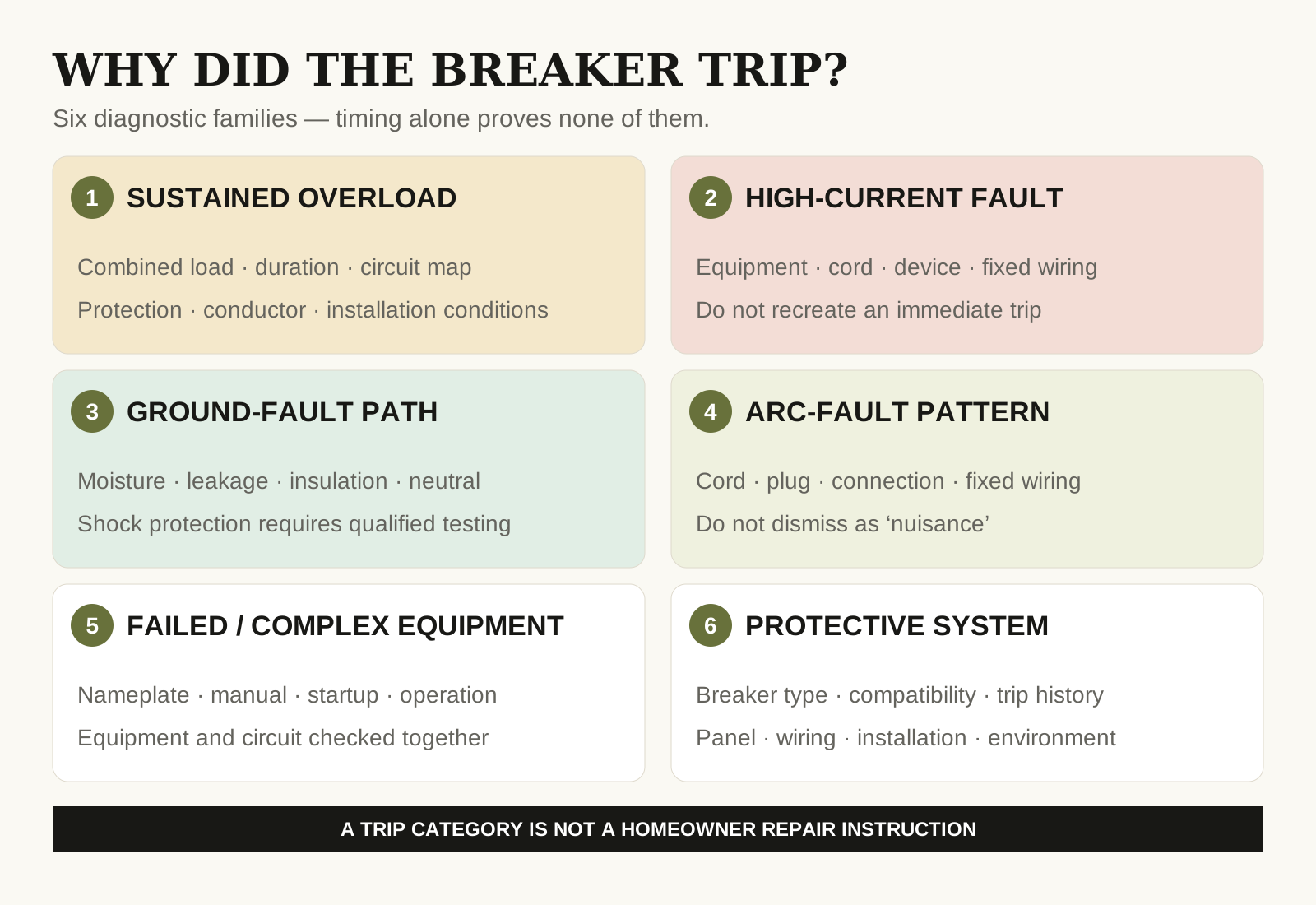
Six cause families an electrician separates
1. Sustained overload
An overload occurs when connected loads ask the branch circuit to carry more current than its protection and wiring are intended to serve for the relevant conditions. Several heat-producing appliances on a shared circuit are a common planning example, but the visible room is not necessarily the circuit boundary. A trip after loads operate for a while may be consistent with thermal overcurrent behavior; it does not prove the circuit is merely “too busy.”
2. Short-circuit or other high-current fault
An unintended low-impedance connection can produce high current and rapid protective action. Damage can exist in equipment, a cord, a plug, a receptacle, a switch, a junction, or fixed wiring. Homeowners should not try to identify it by reconnecting devices one at a time or watching for another immediate trip.
3. Ground-fault or leakage condition
Current may be taking an unintended path, sometimes involving moisture, damaged insulation, equipment, wiring arrangement, or other circuit conditions. GFCI protection is intended to reduce shock risk. A wet exterior box, appliance, pump, HVAC unit, kitchen device, or bathroom load needs the proper specialty response—not drying, bypassing, or repeated energizing from a general guide.
4. Arc-fault detection
An AFCI is designed to detect specified arcing conditions associated with damaged wiring or connections. CPSC explains that such arcing can otherwise create hidden overheating and fire risk. An AFCI trip should not be dismissed as nuisance behavior because a lamp or appliance previously worked. Cord damage, plugs, devices, fixed wiring, installation, and connected equipment all remain candidates for qualified evaluation.
5. Equipment operation or compatibility
A motor, heater, compressor, power supply, electronic control, variable-speed drive, or other equipment can have internal failure, leakage, starting current, electrical noise, or installation requirements relevant to the trip. That does not justify swapping the breaker for a different type. The electrician and equipment specialist need the nameplate, manual, circuit arrangement, protective requirements, and recorded timing.
6. Protective-device, panel, or wiring issue
The breaker itself, its compatibility, terminations, neutral arrangement, bus connection, circuit wiring, device installation, or environmental conditions may require evaluation. Panel equipment is not selected by physical fit or matching amperage alone. Schneider’s current page, for example, expressly says two of its residential breaker families are not interchangeable. Replacement, even with the same printed number, is not a safe diagnostic experiment.
Record timing without re-creating the trip
| Observed event | Useful question | What it does not prove |
|---|---|---|
| Trip occurred after several loads ran | Which loads, modes, start times, rooms, and prior circuit changes? | That overload is the only cause |
| Trip coincided with one appliance starting | Exact appliance, mode, nameplate/manual, cord condition, and service history? | That the appliance alone is defective |
| Trip was immediate | What changed just before it—plugging, switching, water, impact, or work? | That a short circuit is confirmed |
| Trip follows rain or damp conditions | Which exterior, garage, bath, kitchen, pump, or HVAC equipment was involved? | That visible drying makes re-energizing safe |
| Trip is intermittent | Time, occupancy, equipment cycle, weather, vibration, and recent changes? | That the condition is harmless because it cleared |
| No obvious load was operating | Hardwired, standby, automatic, shared, or concealed loads on the circuit? | That the breaker itself failed |
| Lights dimmed or service changed elsewhere | Did other circuits or the whole building show symptoms? | That this is a single branch-circuit problem |
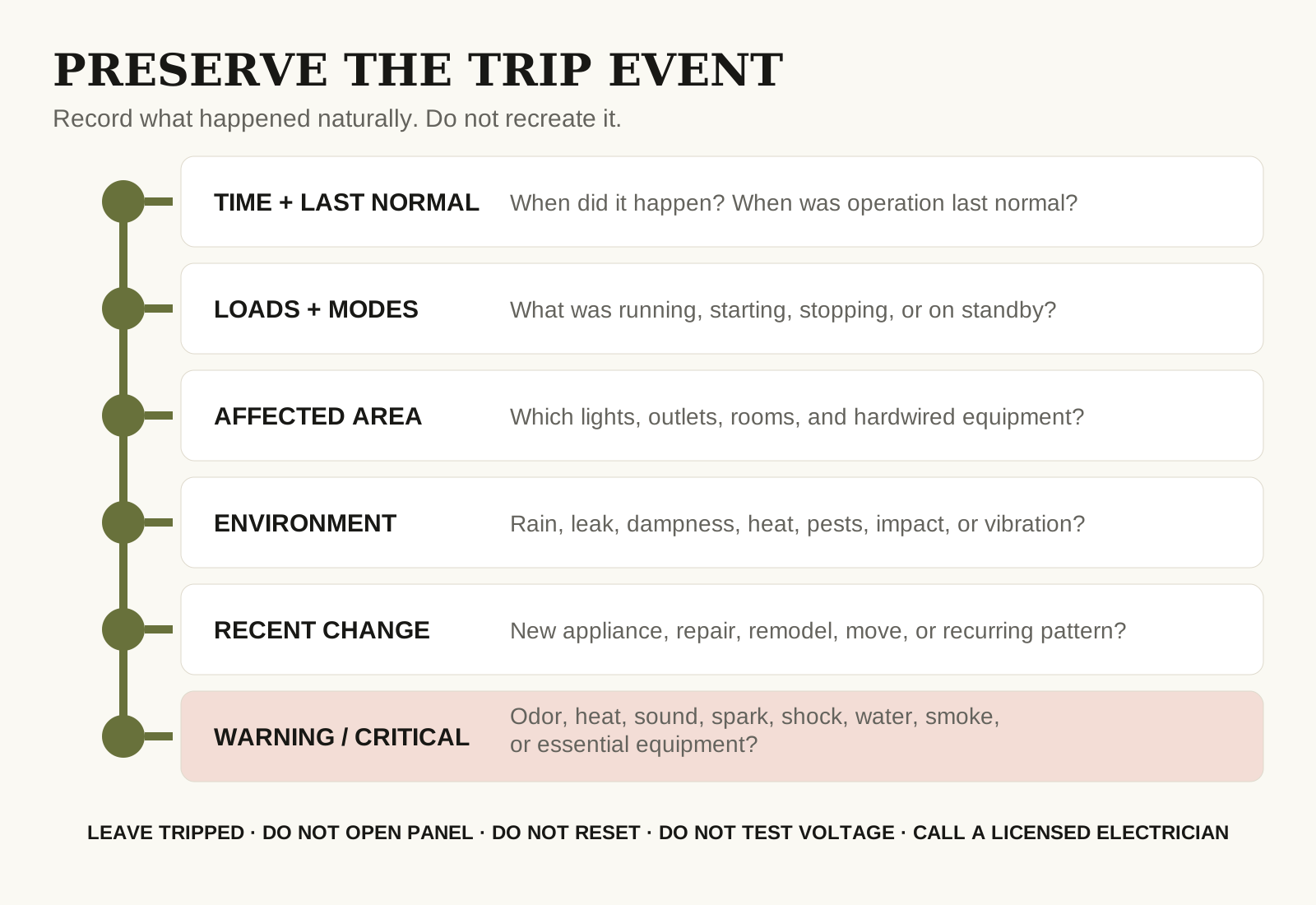
Write down what happened from memory and ordinary records. Do not repeat a switch sequence or reconnect a suspect device to improve the log. “Trips after ten minutes” is useful only if that happened naturally before the stop; it is not an invitation to time another run. Photograph intact cord-connected equipment and nameplates only when cool, dry, accessible, and away from electrical hazards. Do not open covers.
Preserve any manufacturer-specific indicator state for the electrician without interpreting or clearing it. Some breakers store trip history; others use different button, indicator, or diagnostic behavior. Do not open a panel door, reach around a deadfront, press breaker test buttons, or operate the handle for this article. If a professional gives site-specific instructions, follow that professional’s safety plan—not a generic online reset sequence.
What to do before the electrician arrives
- Leave the circuit in its tripped state. Keep people from operating switches or loads served by it. Do not tape, wedge, hold, or bypass any protective device.
- Stop using suspect equipment. Only if a cord-connected item and its surroundings are cool, dry, undamaged, silent, and normally accessible, switch it off and unplug it by the plug body. Do not touch wet, hot, damaged, buzzing, sparking, or hardwired equipment.
- Protect critical needs through the correct plan. For medical, refrigeration, sump, alarm, communications, mobility, or other critical equipment, follow its manufacturer or facility emergency procedure and tell the electrician. Do not improvise permanent extension-cord routing or transfer equipment between circuits without confirming suitability.
- Build the event record. List affected rooms, lights, outlets, and hardwired equipment; the last known normal operation; what started or stopped; weather/water; recent electrical, appliance, pest, or remodeling work; and every warning sign.
- Call a licensed electrician. Describe repeated trips and urgent signs when booking. Ask whether the equipment’s qualified service provider should also attend and what must remain untouched for diagnostic history.
In rentals, condos, and multi-tenant buildings
Report the event through the property’s emergency or maintenance channel as well as the appropriate emergency service when smoke, flame, shock, or another urgent condition exists. Give the exact unit, room, equipment, time, affected common areas, and whether neighbors observed similar symptoms. Do not enter a locked electrical room, reset a shared device, or assume a labeled branch belongs only to your space.
Preserve the line between tenant equipment, unit wiring, common distribution, utility service, and landlord-provided systems until qualified people identify it. A countertop appliance may be tenant-owned while the receptacle and branch circuit are building systems; a hardwired HVAC, cooking, laundry, elevator, pump, access-control, fire-alarm, or commercial appliance can involve separate service companies and operational plans. Coordinate access with management, but never delay 911 for an active fire or expose occupants to investigate ownership.
For a business, record what process stopped and which safe shutdown procedure was followed. Protect food, medication, data, security, and accessibility needs through approved continuity plans. Do not move loads to an adjacent tenant, daisy-chain strips, or connect temporary generation without a designed and authorized transfer method.
What qualified diagnosis should answer
The electrician should identify the circuit and protective-device type from the actual equipment and records, not from a homeowner’s guess. The investigation may evaluate trip history, connected and automatic loads, branch wiring, devices, cords, equipment, neutrals and grounding paths, moisture, installation, terminations, panel compatibility, and available manufacturer information. Testing and energized/de-energized controls belong to the electrician.
The final explanation should distinguish the observed trip from the verified cause. “Stopped tripping after appliance X was unplugged” is correlation until the circuit and equipment are properly evaluated. “Overload” should connect to an actual circuit/load assessment. “Ground fault” or “arc fault” should connect to device-specific diagnostic evidence and the condition found. “Bad breaker” should include compatibility and why circuit or equipment conditions were ruled out.
Ask the service record to keep those layers separate. Useful documentation identifies the circuit and protective device as found, the naturally occurring event evidence, the tests the electrician performed, the condition actually verified, the work completed, and any limit or unresolved condition. If an intermittent trip cannot be reproduced safely, that is something to document—not permission to assume it disappeared. Where selective construction access is required, mark its location and extent before finishes are opened so the electrical finding, photographs, inspection needs, and assembly-restoration scope remain tied to the same area.
Repairs may involve equipment service, a cord/device, fixed wiring, a branch-circuit change, correction of moisture or damage, or protective equipment. The answer cannot be chosen from an online symptom list. Permits, code edition, listing, manufacturer instructions, panel compatibility, and inspection needs are project- and jurisdiction-specific and should be verified before work.
When a general contractor is part of the fix
A general contractor is not a substitute for the electrical contractor. Esquives becomes relevant when the verified electrical plan needs selective drywall, plaster, cabinet, flooring, or ceiling access; protection of occupied areas; coordination with equipment replacement; restoration of fire, sound, air, or finish layers; or sequencing within a remodel. Electrical safety, lockout, testing, wiring, terminations, breakers, and panel work stay with the electrician.
If moisture is involved, the qualified source must be found and corrected before electrical equipment is returned to service or assemblies are closed. Plumbing, HVAC, appliance, envelope, and environmental specialists may be needed. Suspected asbestos, lead, mold, or contaminated material requires its own qualified assessment before disturbance. Do not cut exploratory holes around an electrical circuit based on the trip location.
Any roof, roof-deck, flashing, penetration, or roof-leak evaluation and repair belongs to a qualified roofing contractor. Esquives does not offer roofing services. An interior stain or a trip during rain does not identify a roof defect; the source and electrical impact must be verified separately.
Five repeated-trip myths
- “It is only an overload.” Overload is common enough to consider, but repeated trips can involve equipment, wiring, ground-fault, arc-fault, moisture, installation, or protective-device conditions.
- “If it trips instantly, it must be a short.” Timing can guide questions, but exact protection, trip history, wiring, equipment, and event context still need qualified testing.
- “An AFCI is too sensitive.” The trip may reflect arcing, equipment, wiring, installation, self-test, or other product-specific conditions. “Nuisance” is not a diagnosis and protection should not be removed or downgraded casually.
- “A bigger breaker will stop it.” Changing rating or type can defeat the relationship among conductors, equipment, installation, available fault current, listing, and required protection. Never upsize or substitute from this symptom.
- “I can isolate it by resetting after each appliance.” Repeatedly energizing a possible fault can worsen risk and clear useful diagnostic history. Give the electrician the natural event record instead.
Breaker-trip questions
Can I reset a breaker one time?
This guide intentionally stops before panel access or reset. With repeated trips, unknown labels, special protection, critical loads, or any heat, odor, sound, damage, shock, water, smoke, or service symptom, leave it off and call a licensed electrician.
Does tripping after a few minutes prove overload?
No. Duration may be consistent with thermal behavior, but equipment operation, connections, environment, protective type, and other conditions can produce patterns that look similar.
Could one appliance cause the trip?
Yes, equipment or its cord can be involved, but coincidence at startup is not proof. Keep suspect equipment out of service and have the appliance and circuit evaluated together.
Should I replace an AFCI with a standard breaker?
No. Protection requirements and breaker compatibility are not chosen from annoyance or physical fit. A licensed electrician should identify why it tripped and verify the required listed equipment.
Can Esquives troubleshoot the breaker?
Electrical troubleshooting belongs to a licensed electrical contractor. Esquives can coordinate construction access and finish restoration after the electrical scope is defined.
Sources and verification
Primary government, California trade-scope, and manufacturer sources opened and checked August 8, 2026:
- U.S. Fire Administration: Fire Safety for Older Adults
- U.S. CPSC: Home Electrical Safety Checklist
- Eaton: Residential Products Guide
- Schneider Electric: QO Circuit Breaker Protection FAQs
- California CSLB: C-10 Electrical Study Guide
Manufacturer claims are used only to distinguish protective functions, product-specific trip diagnostics, and compatibility limits. They do not select a breaker, interpret this home’s trip, or replace adopted-code and authority review.
Scope: General education, not an electrical, equipment, fire, moisture, structural, environmental, roof, code, permit, product-selection, or project diagnosis. Do not open a panel, operate/reset/replace a breaker, test voltage, touch conductors, bypass protection, or rewire from this guide. Electrical work requires a qualified licensed electrician. Roofing requires a qualified roofing contractor; Esquives does not offer roofing services.