AB 2533 became Chapter 834 on September 28, 2024, and took effect January 1, 2025. Effective January 1, 2026, SB 543 “amended and renumbered” former Government Code section 66332 as section 66311.7 and updated the fee cross-reference. Older city and county pages may still cite section 66332.
| Question | Verified answer as of August 7, 2026 | Important limit |
|---|---|---|
| Is AB 2533 in effect? | Yes. Effective January 1, 2025. | Current citation: Government Code section 66311.7, formerly section 66332. |
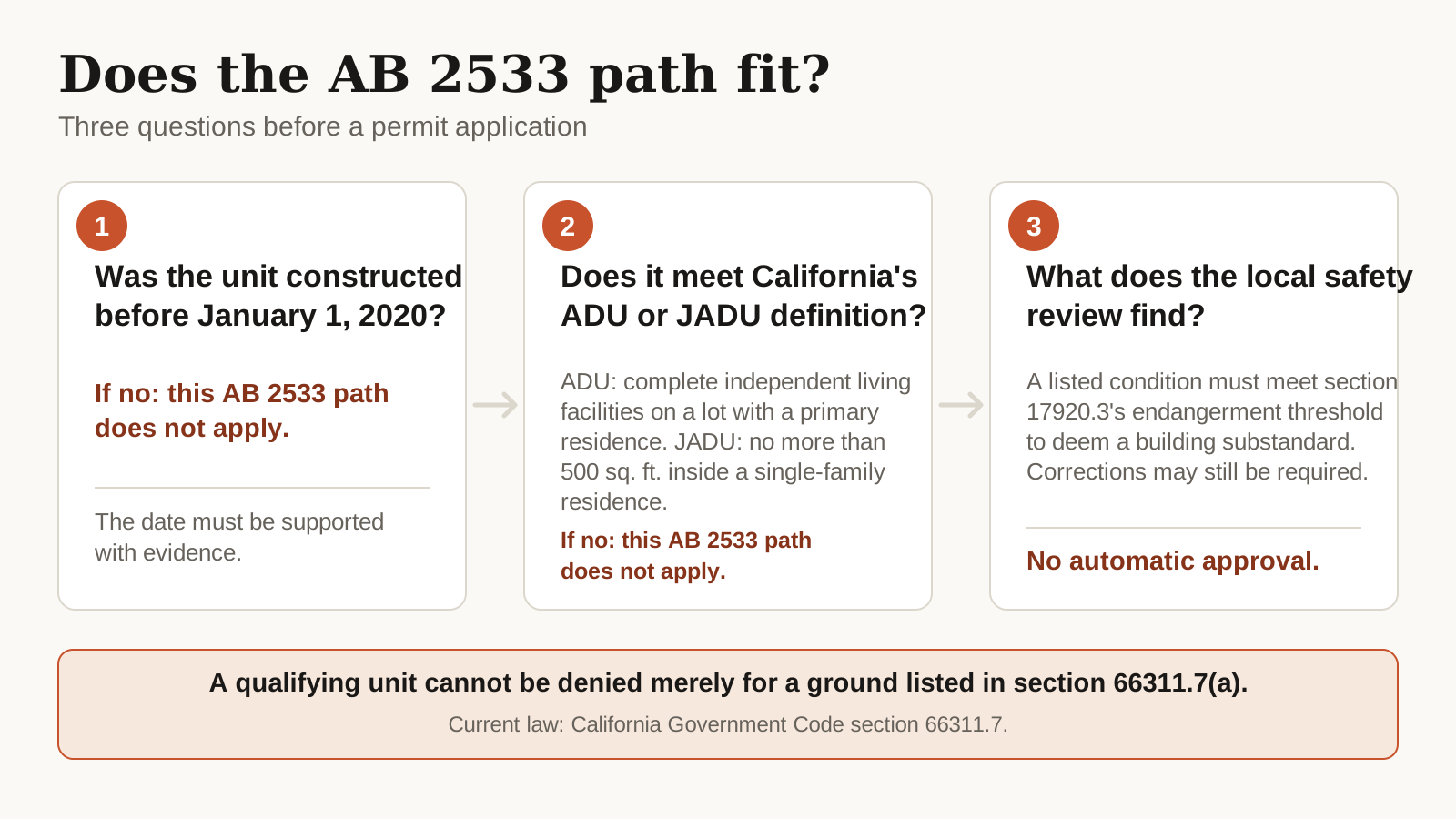
| What date qualifies? | The unpermitted ADU or JADU must have been constructed before January 1, 2020. | A unit first created on or after that date is outside this path. |
| Is approval automatic? | No. The owner applies, documents the unit, and follows the local safety-review process. | A substandard-building finding under Health and Safety Code section 17920.3 can trigger corrections or denial. |
| Are all fees waived? | No. The statute protects against impact fees and connection or capacity charges, subject to a narrow utility-infrastructure exception. | Permit, plan-check, inspection, and other review fees can still apply. |
| Does it cover any unpermitted work? | No. It covers qualifying ADUs and JADUs. | A patio cover, carport, shed, room addition, or other work is not covered merely because it sits near an ADU. |
Status checked against the chaptered bill and current California code. HCD's March 2026 ADU Handbook was used only where it agrees with current statutory text; local guidance was opened on August 7, 2026.
What AB 2533 actually protects
The operative rule is narrow and powerful. For a covered pre-2020 unit, a local agency shall not deny the permit due to a building-standard violation identified in subsection (a)(1), or the state provisions and local ADU/JADU ordinances identified in subsection (a)(2). This can protect an older unit that does not match today's setback, lot-size, height, parking, or similar local ADU standards.
Do not turn that protection into a blanket rule about every state-law issue. Current subsection (a)(2) specifically names “this article or Article 3 ... as applicable,” plus local ADU/JADU ordinances. If a disputed decision turns on a different state provision, ask the agency to identify its authority in writing and consult a qualified attorney.
That does not turn every defect into an approved condition. A local agency may deny when it makes the safety finding described in Government Code section 66311.7(b). The entire section also does not apply to a building deemed substandard under Health and Safety Code section 17920.3.
Does your unit fit the statute?
Start with the unit, not the nickname used in a listing or lease. Under current state law:
- An ADU is an attached or detached residential dwelling unit on the same lot as a proposed or existing primary residence. It provides complete independent living facilities, including permanent provisions for living, sleeping, eating, cooking, and sanitation.
- A JADU has no more than 500 square feet of interior livable space and is contained entirely within a single-family residence. For ordinary permitting, state law requires an efficiency kitchen; the special pre-2020 protection is explained below. Sanitation may be separate or shared.
Those are screening definitions, not a complete permit checklist. Government Code section 66333 ordinarily requires a permitted JADU to include items such as an efficiency kitchen. For this pre-2020 path, however, section 66311.7(a)(2) prevents denial merely because a qualifying JADU does not comply with Article 3, subject to the section 17920.3 safety provisions in subdivisions (b), (c), and (f). Ask the agency to identify the statutory basis for any required correction or denial.
A detached studio with no permanent cooking or sanitation facilities may not meet the ADU definition. Morgan Hill's current guidance says RVs, tiny homes on wheels, yurts, and storage structures generally are not ADUs. San Jose also states that attached patio covers and carports require separate permits and are not included in its AB 2533 legalization process.
The date needs evidence
The statutory cutoff is before January 1, 2020. San Jose places the burden on the applicant to prove that the space was built or converted into an ADU or JADU before that date, not merely that an older underlying structure existed. Its current examples include County Assessor records, prior Building, Planning, or Code Enforcement records, escrow or transfer-disclosure documents, date-stamped photographs, insurance records, past rental contracts, construction invoices or plans, and manufacturer date stamps on building materials or equipment.
If the applicant cannot prove the San Jose space was built or converted into an ADU or JADU before the cutoff, the City says it must be permitted as a new ADU or JADU under the current City building code. Other jurisdictions can use different submittal checklists, so ask the permitting agency which records it will accept before paying for plans.
The safety exception controls the hard cases
Health and Safety Code section 17920.3 does not label every old or imperfect condition “substandard.” Its opening threshold asks whether a listed condition exists to an extent that endangers life, limb, health, property, safety, or welfare of occupants, nearby residents, or the public.
The list is broad. It covers sanitation, hot and cold water, heating, light and ventilation, dampness, visible mold, sewage disposal, structural hazards, unsafe wiring, plumbing and mechanical equipment, failed weather protection, fire hazards, unsafe exits, missing fire-resistive systems, spaces used for living that were not designed for that use, and inadequate resistance to horizontal forces.
Some provisions look back to the law in effect when work was installed and whether systems remain safe and functional. That is one reason a responsible scope cannot be set from photos alone. Existing walls may need selective openings so an inspector can verify framing, wiring, plumbing, and fire-safety conditions.
Consider the optional confidential inspection before filing
Government Code section 66311.7 says a homeowner may obtain a confidential third-party code inspection from a licensed contractor before submitting the permit application. It is optional, not a substitute for the local agency's inspection and not an approval.
The practical value is sequencing. A pre-application inspection can identify likely structural, electrical, plumbing, mechanical, moisture, egress, and fire-safety work before those corrections must be drawn into as-built plans. It can also help the owner decide whether to proceed before an application triggers the local review process.
Keep the scope precise. Ask the contractor to document observed conditions and limitations, separate visible facts from items that require destructive testing, and map each recommended correction to the jurisdiction's published section 17920.3 checklist. No private inspector can promise what the city or county will find.
San Jose's current AB 2533 process
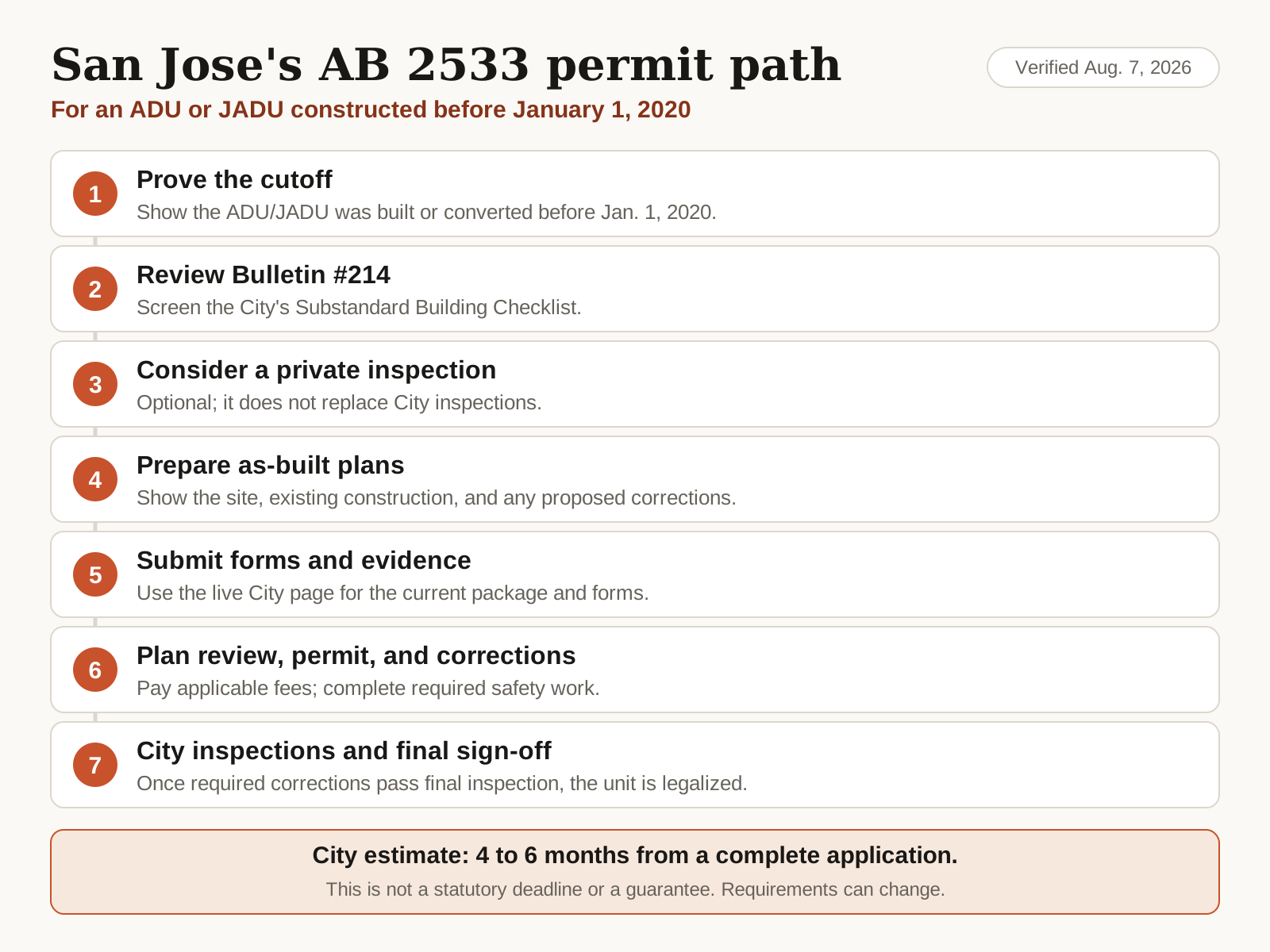
Status checked August 7, 2026. San Jose's current program page and August 4, 2026 Bulletin #214 describe the following path. The City currently estimates four to six months from a complete application through final sign-off. That is a City estimate, not a statutory permit-decision deadline or construction schedule.
State law separately sets processing rules for ADU and JADU permit applications. Current Government Code sections 66317 and 66335 generally require a completeness determination within 15 business days, an approval or denial within 60 days after a completed application, and a final written appeal determination within 60 business days. Section 66317 also contains a deemed-approved provision for an ADU application when its stated conditions are met. San Jose's program page does not explain how every one of those rules maps onto its legalization, correction-work, and final-inspection sequence, so ask the City to identify the applicable permit-decision timeline in writing. We will re-check the law, forms, fee guidance, inspection instructions, and City estimate by December 15, 2026.
- Confirm the unit and cutoff. Verify that the space meets the ADU or JADU definition and collect records showing it was built or converted into that use before January 1, 2020.
- Review the City's checklist. Use Bulletin #214 to screen the conditions San Jose will examine under Health and Safety Code section 17920.3.
- Consider the optional private inspection. Use a qualified licensed professional within the scope allowed by the City and state law to identify likely corrections before filing.
- Prepare as-built plans. San Jose calls for a site plan plus scaled plans showing existing foundation, floor and framing plans, elevations, details, and any proposed safety corrections. Exterior photographs are part of the package.
- Submit the local forms and evidence. The package includes construction-date evidence, the signed checklist, as-built plans, a Building Permit Application, and an ADU Property Owner Declaration. Check the live program page for the current email subject line and forms before submitting.
- Complete review and pay applicable fees. Fire review may apply in a Wildland-Urban Interface area or when the main house has sprinklers and the ADU does not. Public Works review may apply in flood or geologic-hazard zones.
- Pass inspections and correct listed conditions. The City checks the plans against the existing unit and verifies that substandard conditions are absent or corrected. Final sign-off is what legalizes the unit.
What AB 2533 does and does not waive
For a covered pre-2020 unit, Government Code section 66311.7(e) says the homeowner shall not be required to pay impact fees or connection or capacity charges. The exception is when utility infrastructure is required to comply with Health and Safety Code section 17920.3 and the charge is authorized under the current utility-fee statute.
That is not a waiver of every project cost. San Jose currently says standard permit, plan-check, and inspection fees apply. Other-department review fees can also apply. The City separately says it does not charge its “Fee for Work Without a Permit” for ADUs and JADUs using this legalization process.
The penalty protection is also specific. After an application is received and an inspector finds health-and-safety noncompliance, the statute says the local agency shall not penalize the applicant for having the unpermitted ADU or JADU and shall approve necessary permits to correct that noncompliance. It does not say that unrelated violations elsewhere on the property disappear.
The state rule is statewide; the file is local
Government Code defines a local agency as a city, county, or city and county, whether general-law or chartered. The ADU chapter also expressly applies to charter cities. The state protection therefore sets the floor. Each local agency administers its current forms, evidence requests, inspection sequence, project-specific corrections, and otherwise lawful local fees, subject to statewide standards, processing deadlines, fee limits, and appeal rights.
| Property location | Official starting point | Do not assume |
|---|---|---|
| City of San Jose | Use the City's AB 2533 program page, FAQ, and current Bulletin #214. | Do not use the standard new-ADU checklist in place of the legalization package. |
| Unincorporated Santa Clara County | The County's AB 2533 page calls for a development permit application, plans, date evidence, and a County inspection. | Do not use San Jose forms for a County parcel. |
| City of Morgan Hill | The City directs ADU applicants to contact Planning before applying for a building permit. Ask specifically for the current section 66311.7 legalization checklist. | Do not assume San Jose's sequence, forms, or timeline applies. |
| Another Bay Area city | Contact that city's building or ADU team and request its pre-2020 unpermitted-ADU process and section 17920.3 checklist. | Do not file with the County merely because the property is in Santa Clara County. |
California requires local agencies to publish a section 17920.3 checklist and tell homeowners about the optional confidential inspection. Current Government Code sections 66317(d) and 66335(e) require an appeal process for application incompleteness determinations or denials. HCD's March 2026 handbook also directs applicants to use the local appeal process for disputed corrections. If the local answer conflicts with the statute, ask for the determination and correction list in writing.
A reader-safe order of operations
- Identify the permitting agency. Confirm whether the parcel is inside a city or in unincorporated County territory.
- Confirm that the space is an ADU or JADU. Do not use the AB 2533 label for a generic addition or accessory structure.
- Build the date file. Gather independent records showing the space was built or converted into an ADU or JADU before January 1, 2020.
- Download the live local checklist. Forms and local instructions can change after this guide's verification date.
- Inspect before designing corrections. Consider an optional private review to identify uncertainty and likely access openings.
- Prepare accurate as-built documents. Plans must show what exists, not what the owner hopes the inspector will find.
- Carry correction and access allowances. Do not promise a fixed construction number before concealed conditions are studied.
Questions homeowners ask
Does a setback violation automatically disqualify the unit?
No. A covered unit cannot be denied solely because it violates a local ADU ordinance, and San Jose specifically lists setbacks among the local development standards protected by AB 2533. That does not resolve a structure outside the parcel, in a recorded easement, or on land that cannot be built upon. San Jose lists those conditions separately in its local eligibility guidance.
Is the unit “grandfathered” because it is old?
No. “Grandfathered” hides the real test. The owner still needs a permit, evidence of the pre-2020 date, qualifying ADU or JADU features, local review, required corrections, inspections, and final sign-off.
Must the unit meet every part of today's building code?
AB 2533 does not create a simple all-current-code test. The controlling exception is tied to the substandard-building standards in Health and Safety Code section 17920.3, and some of those standards consider the law in effect at installation plus present safety and condition. The local agency makes the project-specific findings.
Can the local agency inspect the unit?
Yes. Section 66311.7 says an inspector may inspect after the application is received and may recommend work needed for health-and-safety compliance. San Jose's published process includes City inspections and possible selective openings.
Does a private inspection guarantee the permit?
No. The pre-application inspection is optional and confidential. It helps define likely work, but it does not approve existing construction, replace official inspections, or bind the local agency.
Does AB 2533 legalize an unpermitted room addition?
Only if the unit itself meets the state definition of an ADU or JADU and satisfies the rest of the statute. A room addition, patio cover, carport, shed, or other accessory work does not gain protection just because it is connected to a qualifying unit.
Sources and verification
Law and local instructions were verified against the following primary sources on August 7, 2026. The separate research ledger in this draft folder maps each load-bearing claim to exact source language.
- California Legislative Information: AB 2533 chaptered text: enacted language, Chapter 834, approval date.
- California Legislative Information: AB 2533 history: enrollment, approval, and chaptering status.
- California Legislative Information: SB 543 chaptered text: renumbering and the updated fee cross-reference.
- Current California Government Code Chapter 13: sections 66311.7, 66313, 66317, and 66335; present codification, permit protection, exceptions, fees, definitions, processing timelines, and appeals.
- Current California Government Code section 66333: JADU efficiency-kitchen and related requirements.
- California Health and Safety Code section 17920.3: substandard-building threshold and conditions.
- California HCD: current ADU Handbook page and March 2026 handbook PDF: current update status and statements independently consistent with current statutory text; the research ledger records internal version drift.
- California HCD: March 24, 2026 technical-assistance letter: scope of section 66311.7 and the ADU-definition limit.
- City of San Jose: AB 2533 legalization program: current eligibility, submittal, review, inspections, final sign-off, and City timeline estimate.
- City of San Jose: AB 2533 legalization FAQs: date evidence, exclusions, fees, inspection access, and code questions.
- City of San Jose Bulletin #214, August 4, 2026: application package and Substandard Building Checklist.
- County of Santa Clara: AB 2533 legalization program: unincorporated-County process, evidence, plans, and inspection.
- City of Morgan Hill: Accessory Dwelling Units: local definitions and direction to contact Planning before a building-permit application.
This article provides general construction and permit-planning information, not legal advice or a parcel-specific code determination. AB 2533 applies only to qualifying ADUs and JADUs. Construction date, property boundaries, easements, hazards, existing conditions, local procedures, utility work, fees, and required corrections vary. Confirm the current checklist and written requirements with the permitting agency for the property; consult a qualified attorney for a disputed denial or legal-rights question.