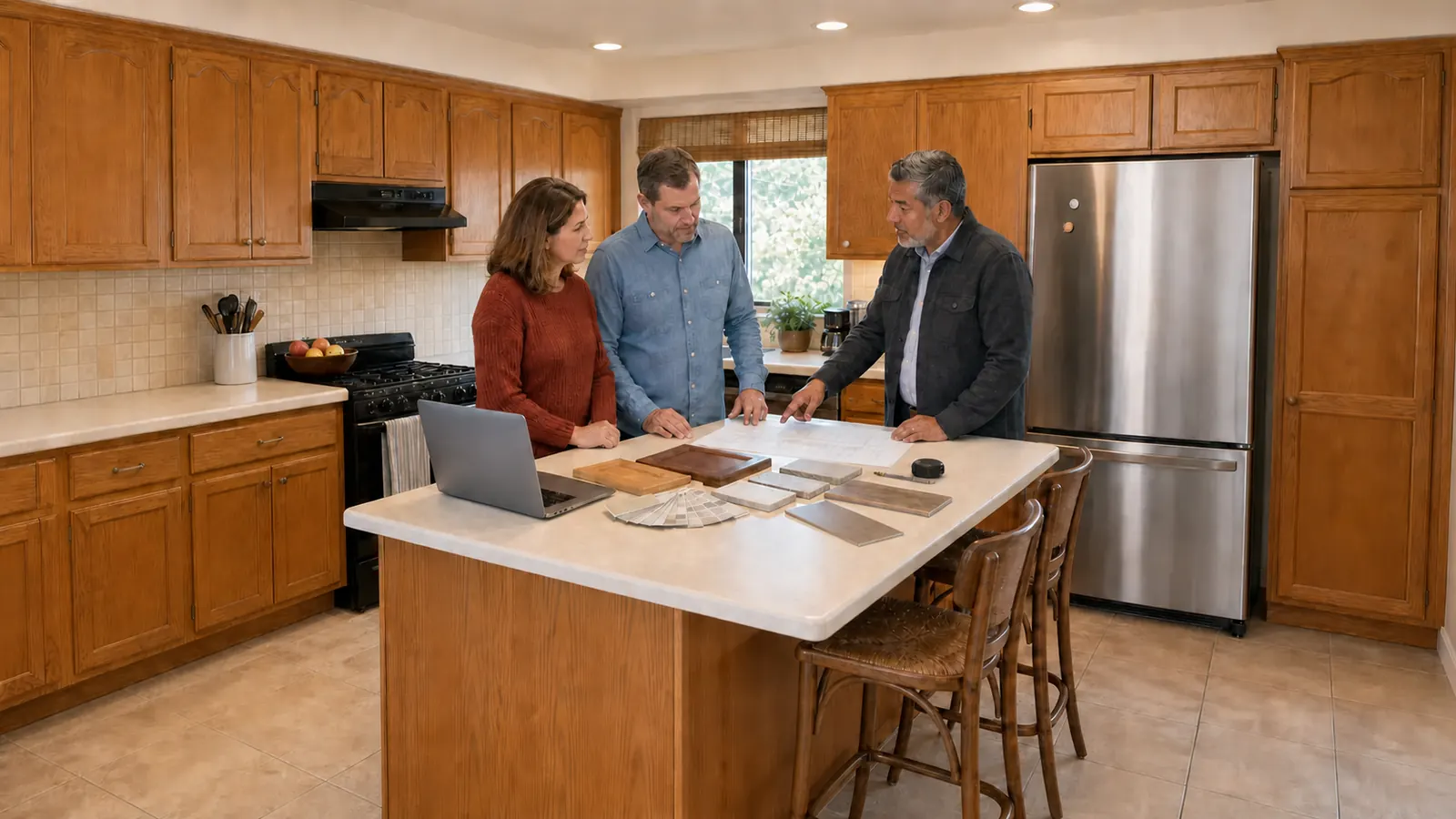
A useful kitchen budget begins with a defined scope. “New kitchen” can mean repainting while keeping cabinet boxes, or it can mean moving walls, rebuilding utilities, ordering custom cabinetry, and replacing every finish. Those are not neighboring versions of one product.
No current public source we found supplies a representative sample of signed 2026 San Jose kitchen contracts with matched scope. This guide therefore does not present a San Jose average. It builds broad editorial planning bands from two independent forms of evidence, shows the assumptions next to the numbers, and states where that evidence stops.
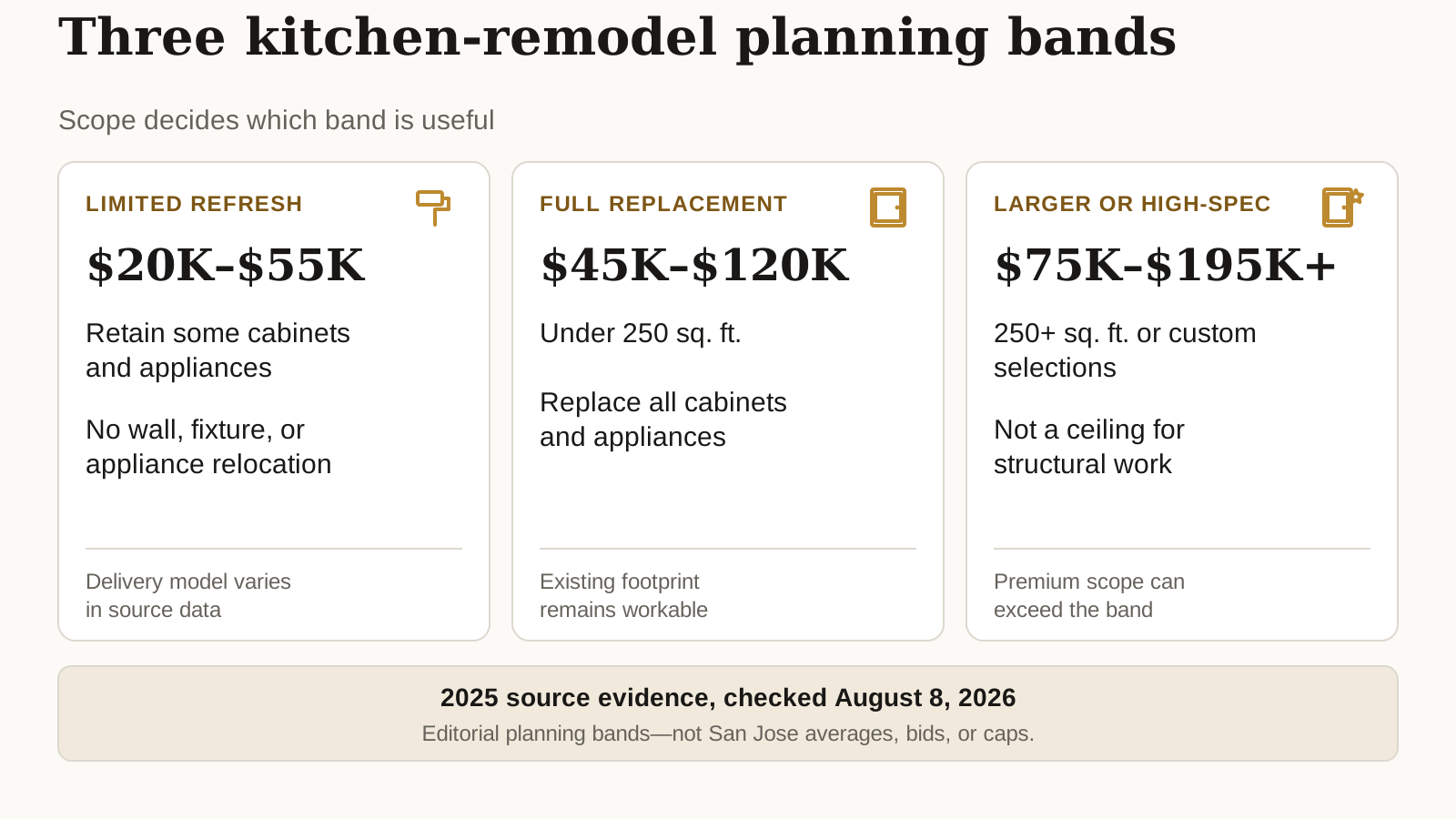
Three 2026 kitchen-remodel planning bands
| Editorial planning band | Planning range | Use it when |
|---|---|---|
| Limited multi-component refresh | $20K–$55K | You retain some cabinets and appliances and do not relocate a wall, fixture, or appliance. |
| Full replacement, smaller kitchen | $45K–$120K | The kitchen is under 250 square feet; all cabinets and appliances are replaced; the footprint remains workable. |
| Larger or high-spec remodel | $75K–$195K+ | The kitchen is 250 square feet or larger, or a smaller room receives custom or premium selections. |
The overlaps are intentional. A compact custom kitchen can cost more than a larger room using stock products, while careful reuse can keep a larger kitchen below its apparent category. Use the range that matches the final scope, then replace it with a written project-specific proposal.
How the bands were calculated
The 2026 Houzz U.S. Kitchen Trends Study reports 2025 project spending. Its overall median was $20,000 for a minor remodel. For large minor remodels, the 90th-percentile threshold was $53,000. The 2025 JLC Cost vs. Value San Francisco market page modeled a 200-square-foot minor kitchen at $31,804. We take the evidence envelope from $20,000 to $53,000 and round its upper edge outward to the nearest $5,000: $20,000–$55,000.
For a major remodel under 250 square feet, Houzz reports a $46,000 median and a $120,000 90th-percentile threshold. JLC’s standardized 200-square-foot midrange major kitchen cost $97,667, inside that envelope. Rounding the lower edge outward produces $45,000–$120,000.
For large major kitchens, Houzz reports a $75,000 median and a $150,000 90th-percentile threshold. JLC’s 200-square-foot upscale model cost $192,231. Rounding that higher anchor outward gives $75,000–$195,000-plus. The plus sign matters because structural work, relocated utilities, custom fabrication, and hidden conditions can exceed a standardized finish model.
What the two price sources actually measure
Houzz surveyed registered U.S. Houzz users from July 6 through July 30, 2025. The overall study included 1,780 homeowners age 18 or older who had completed a kitchen remodel in the previous 12 months, were working on one, or planned one within six months. The report says the sample was weighted to the Houzz user population using Houzz & Home weights. Its spending figures cover projects completed by mid-2025 and were not adjusted for inflation. Houzz defines a major remodel as replacing at least all cabinets and appliances; a minor remodel does not replace all of both. “Large” means 250 square feet or more and “small” means under 250. The report does not disclose a separate sample count for each dollar cell.
JLC measures something different: standardized projects, not homeowner invoices. Each kitchen scope is 200 square feet with 30 linear feet of cabinetry. The minor model keeps cabinet boxes and changes fronts, hardware, counters, appliances, sink, flooring, and paint. The midrange major model replaces the kitchen with semi-custom cabinetry, an island, appliances, sink, flooring, and finishes. The upscale model uses custom cabinetry and premium surfaces, fixtures, lighting, and appliances. JLC says its model uses national economic data and local variation from Verisk XactRemodel. Its own guidance warns that small scope changes can change price dramatically.
Choose by scope, not by finish-name shorthand
- Inventory what stays. Record every cabinet box, appliance, counter, sink, faucet, light, floor, wall, and window that remains. “Refresh” stops being useful when most of that list is being replaced.
- Mark every location change. Moving a sink, range, wall, window, or appliance affects trade coordination and can change the permit path. A few feet on a sketch can mean opening more wall or floor than expected.
- Set product allowances before comparing totals. Cabinet construction, door style, countertop material, appliance package, tile coverage, fixtures, and lighting need named allowances or specified products. “Midrange” is not a product specification.
- Separate known scope from reserves. Demolition, protection, disposal, electrical, plumbing, mechanical work, patching, paint, and final cleaning belong in the scope. A reserve is for uncertainty, not for work everyone already knows must happen.
Five scope decisions that move the number most
Cabinet strategy comes first. Resurfacing sound boxes, replacing every cabinet with a semi-custom package, and commissioning custom casework are three different scopes. Count linear runs, tall pantry units, appliance panels, islands, specialty storage, finished ends, and trim. A door style alone does not describe what is being priced.
Layout changes create connected work. Moving the sink or range can affect supply, waste, venting, gas or electrical service, flooring, wall repair, and inspection. Removing or changing a wall may require structural investigation and plans. A proposal should describe the downstream work instead of hiding it in a single “relocate” line.
Appliance specifications affect more than the appliance allowance. Confirm exact dimensions, electrical load, gas or induction choice, ventilation, water connection, panels, fillers, and required clearances before cabinets are released. An appliance purchased separately is still a design input.
Finish coverage must be measurable. Countertop edge, backsplash limits, tile pattern, flooring transitions, paint limits, under-cabinet lighting, decorative fixtures, and hardware quantity all belong on the scope sheet. Two proposals can use the same material name while pricing different quantities and installation details.
Existing conditions remain the largest unknown until investigated. Water damage, out-of-date or crowded systems, uneven floors and walls, hazardous paint, and concealed framing cannot be converted into one universal allowance from public cost data. Document what is visible, identify what can be tested before construction, and state how discoveries will be priced and approved.
What needs a San Jose kitchen permit?
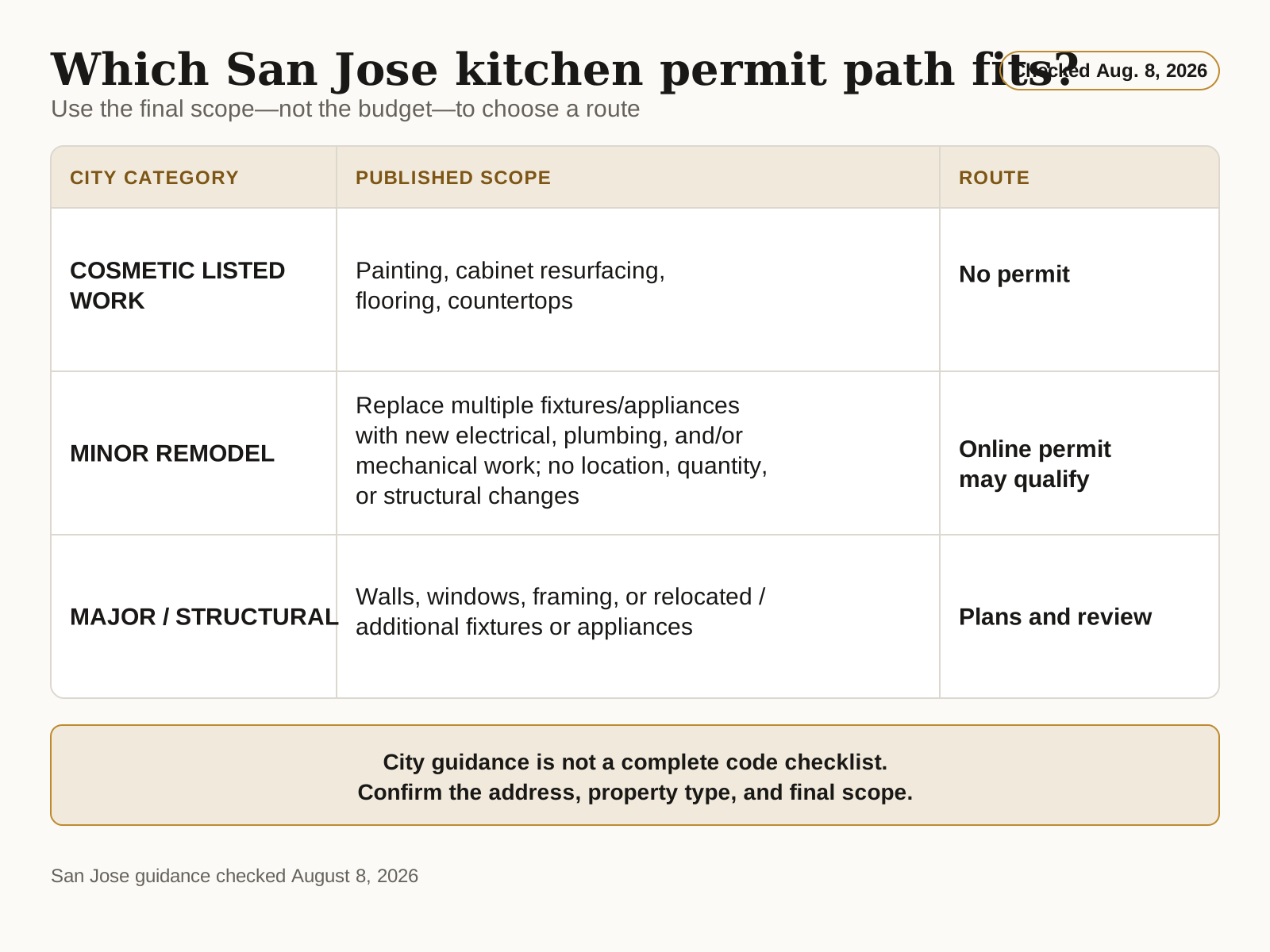
Price does not determine the permit route; scope does. The City’s minor kitchen and bathroom remodel page, updated April 13, 2026, lists painting, cabinet resurfacing, new flooring, and new countertops as work that does not require a permit. That is a specific cosmetic list, not a blanket exemption for a project that also changes regulated systems.
The City describes a minor remodel as replacing multiple fixtures or appliances with associated new electrical, plumbing, or mechanical work while leaving their locations and quantities unchanged and doing no structural work. That path may qualify for an easy online permit. A major remodel changes walls, windows, or framing, or relocates or increases fixtures or appliances. Structural remodels require plans and review; the correct route still depends on the property and final scope.
Do not turn the City checklist into a complete design
San Jose has adopted the 2025 California codes, effective January 1, 2026. The City’s minor-remodel checklist calls for kitchen exhaust to duct outdoors and flags third-party HERS verification for a replacement range hood; it also lists 100 CFM and Energy Star requirements. That checklist is a starting point, not a substitute for a project-specific electrical, plumbing, mechanical, energy, structural, or product review.
The City’s beta fee estimator covers named project types, not a generic kitchen remodel. For other work, San Jose directs users to the current fee worksheet or staff. A source-based article therefore cannot assign one universal kitchen permit fee. Get the route and submitted scope settled first, then confirm current City charges.
A proposal should separate the contractor’s permit-coordination work from City charges. Ask who will prepare any drawings or supporting documents, submit the application, respond to review comments, schedule inspections, and correct work if an inspection identifies an issue. Then ask whether plan preparation, outside design or engineering, City plan-review and permit fees, and reinspection costs are included, allowed for, or excluded. That structure does not predict the fee or approval path; it prevents a homeowner from mistaking an omitted administrative scope for a lower construction price. If the layout or product schedule changes after submittal, confirm who evaluates whether the approved documents also need to change.
Contracts, licensing, and tax are separate budget questions
California uses two different thresholds that are easy to confuse. The Contractors State License Board says a home-improvement agreement over $500, including labor and materials, must be in writing. The contract should describe the products and work, payment schedule, permits, and completion, and changes should be documented with signed change orders.
The separate small-job contractor-license exemption is limited to work of a casual, minor, or inconsequential nature with an aggregate price below $1,000, including labor and materials. It does not apply when a building permit is required, another person is employed to perform or assist with the work, a larger operation is divided to evade the law, or the person advertises or represents that they are a contractor. A normal professionally delivered kitchen remodel generally exceeds both dollar thresholds, but the rules do different jobs: $500 triggers the written home-improvement contract requirement; less than $1,000 is only one condition of a narrow contractor-license exemption.
CSLB’s consumer guidance states that a down payment may not exceed the lesser of $1,000 or 10 percent of the contract price, and that progress payments may not exceed the value of work performed or materials delivered. Business and Professions Code section 7159.5(a)(8) has a narrow exception when the contractor furnishes registrar-approved performance-and-payment bond protection, an approved equivalent, or approved joint control covering full performance and payment. These are contract protections, not additions to a cost band.
That distinction explains why a planning band cannot add one universal “sales tax” line. A lump-sum contract, time-and-material contract, contractor-furnished fixture, and owner retail purchase do not necessarily carry tax in the same way. The official rate is a current fact; the taxable base is contract- and item-specific.
Property assessment and property type
The California State Board of Equalization says normal maintenance and repair typically are not new construction for property-tax assessment. An extensively altered kitchen may be treated as new construction if it is equivalent to a new kitchen, but that is a case-by-case assessor determination. Added assessed value is not necessarily the construction bill, and a permit does not mean the entire home is automatically reassessed.
For a condominium, multifamily building, or property governed by an HOA, do not assume the single-family route or these bands answer every question. Confirm the property type with the City, and review the governing documents or ask the property manager about any separate approval, access, work-hour, common-area protection, or building-systems questions. This guide assigns no generic cost or requirement to those possibilities.
How to compare kitchen proposals without fooling yourself
| Ask for | Why it matters | Red flag |
|---|---|---|
| One written scope baseline | Every bidder prices the same items, locations, and finish level. | One total says “complete kitchen” with no inclusions. |
| Named allowances or selections | Cabinets, counters, appliances, tile, fixtures, lights, and flooring can be compared. | “Standard” or “builder grade” is undefined. |
| Permit and professional-service responsibility | You can see who prepares documents, submits, answers comments, pays fees, and attends inspections. | “Permits by owner” without explaining the actual route. |
| Tax, demolition, disposal, protection, and patching | These are common scope gaps, not surprises to discover after award. | They are absent from both inclusions and exclusions. |
| Payment schedule and signed change process | Payments follow delivered work and scope changes become traceable. | A large early payment or verbal-only changes. |
Also ask how the contractor will protect occupied areas, control dust, maintain safe access, isolate utilities, and handle the period when the kitchen cannot be used. If paid work will disturb painted surfaces in a pre-1978 home, EPA’s Renovation, Repair and Painting program may require a certified firm and lead-safe practices. The right planning response is to identify the condition—not invent a generic lead allowance.
Before signing, compare the contractor’s active license and the exact company name, then reconcile every proposal against the same scope sheet. A lower total may be a good price, or it may simply omit appliances, electrical work, finish installation, permit coordination, or restoration that another proposal includes.
What current evidence cannot support
These sources cannot establish a 2026 San Jose average, a neighborhood multiplier, a guaranteed “typical” permit fee, a universal contingency percentage, or a reliable return on investment for your address. They also cannot turn JLC’s fixed 200-square-foot models into a scalable per-square-foot rate. Historical 2024 San Jose JLC figures exist, but inflating them and mixing them with 2025 denominators would create a synthetic local number rather than an observation.
Houzz’s 90th-percentile thresholds are not maximums, and the planning bands are not forecasts. They are a disciplined way to decide whether an early idea is plausibly a refresh, a full replacement, or a larger/high-spec project before design and trade investigation replace assumptions with facts.
Questions San Jose homeowners ask
Can a cosmetic kitchen update cost less than $20,000?
Yes. The $20,000 lower edge comes from Houzz’s national minor-remodel median, a spending cell that is not filtered by delivery model. Paint-only, single-component, owner-installed, or DIY work can fall below it, while a contractor-led multi-trade refresh can start above it. The band is an early planning envelope, not a price floor.
Is a $100,000 kitchen automatically “high end”?
No. In the source evidence, $100,000 sits inside both the smaller full-replacement band and the larger/high-spec band. Room size, cabinet quantity and construction, appliances, surfaces, layout, trade work, and what the proposal includes determine what the total represents.
Do new countertops require a San Jose permit?
The City lists new countertops among cosmetic work that does not require a permit. If the same project adds regulated electrical, plumbing, mechanical, location, quantity, or structural changes, use the complete scope to determine the route rather than treating the countertop line as an exemption for everything else.
Should I add 10% San Jose tax to the whole bid?
No. San Jose’s total sales and use tax rate is 10.000%, effective April 1, 2026, but CDTFA’s construction-contractor rules distinguish materials from fixtures and make contract form relevant. Have the proposal state what tax is included; do not apply the rate blindly to the total contract.
Sources and verification
The linked price sources were opened and checked August 8, 2026, and the price evidence remains in 2025 dollars. San Jose’s fee page and beta-estimator coverage were rechecked September 1, 2026 and remained unchanged. The next City and statutory review is December 1, 2026; annual price-evidence review remains January 20, 2027, or sooner if a newer matched-year Houzz or JLC source appears. Tax, contract, permit, code, and assessment claims also receive quarterly and event-triggered checks.
- Houzz: 2026 U.S. Kitchen Trends Study: 2025 reported spending, scope definitions, size bands, survey period, and methodology.
- JLC: 2025 Cost vs. Value, San Francisco; project scopes for minor, major midrange, and major upscale; plus methodology and limitations.
- City of San José: Kitchen & Bathroom Minor Remodels; major and structural remodel routing; adopted codes; and permit fees.
- CSLB: Home-improvement contracts and contractor licensing; California Business and Professions Code sections 7048, 7159, and 7159.5: separate license, written-contract, payment, and narrow statutory-exception rules.
- CDTFA: April 2026 rate-change notice, current tax rates, construction-contractor guidance, and specific-job examples: San Jose effective date, current rate, and materials/fixtures treatment.
- California BOE: New construction property: maintenance, extensive alterations, and case-by-case assessment.
- U.S. EPA: Renovation, Repair and Painting Program: paid renovation work that disturbs paint in pre-1978 housing.
This guide provides general construction-planning information. It is not a bid, tax opinion, legal advice, appraisal, return projection, or address-specific code determination. Costs, site conditions, product choices, contract terms, tax treatment, assessment, and agency requirements vary. Confirm the final scope with qualified professionals and the applicable City, state, tax, licensing, HOA, and assessor authorities.