Homeowners in Morgan Hill, Gilroy, Los Gatos, the Santa Cruz Mountains, and the San Jose foothills are dealing with higher premiums, inspections, and nonrenewals. That makes wildfire work easy to oversell. A contractor should be clear about what construction can do, what an insurer decides, and which rules are actually in force.
Here is the current line between law, insurance incentive, and proposal.
What is actually in effect in 2026?
Why the first improvements focus on embers
A wildfire can expose a home to embers before the flame front arrives. Embers collect at roof edges, enter vents, ignite debris under a deck, or catch a wood fence that touches the house. Home hardening closes those paths.
That is why California's insurance framework combines work on the structure, the first five feet, the wider defensible-space zones, and the surrounding community. One upgrade helps, but the system works best when the weak links are addressed together.
Zone 0: what the law says today
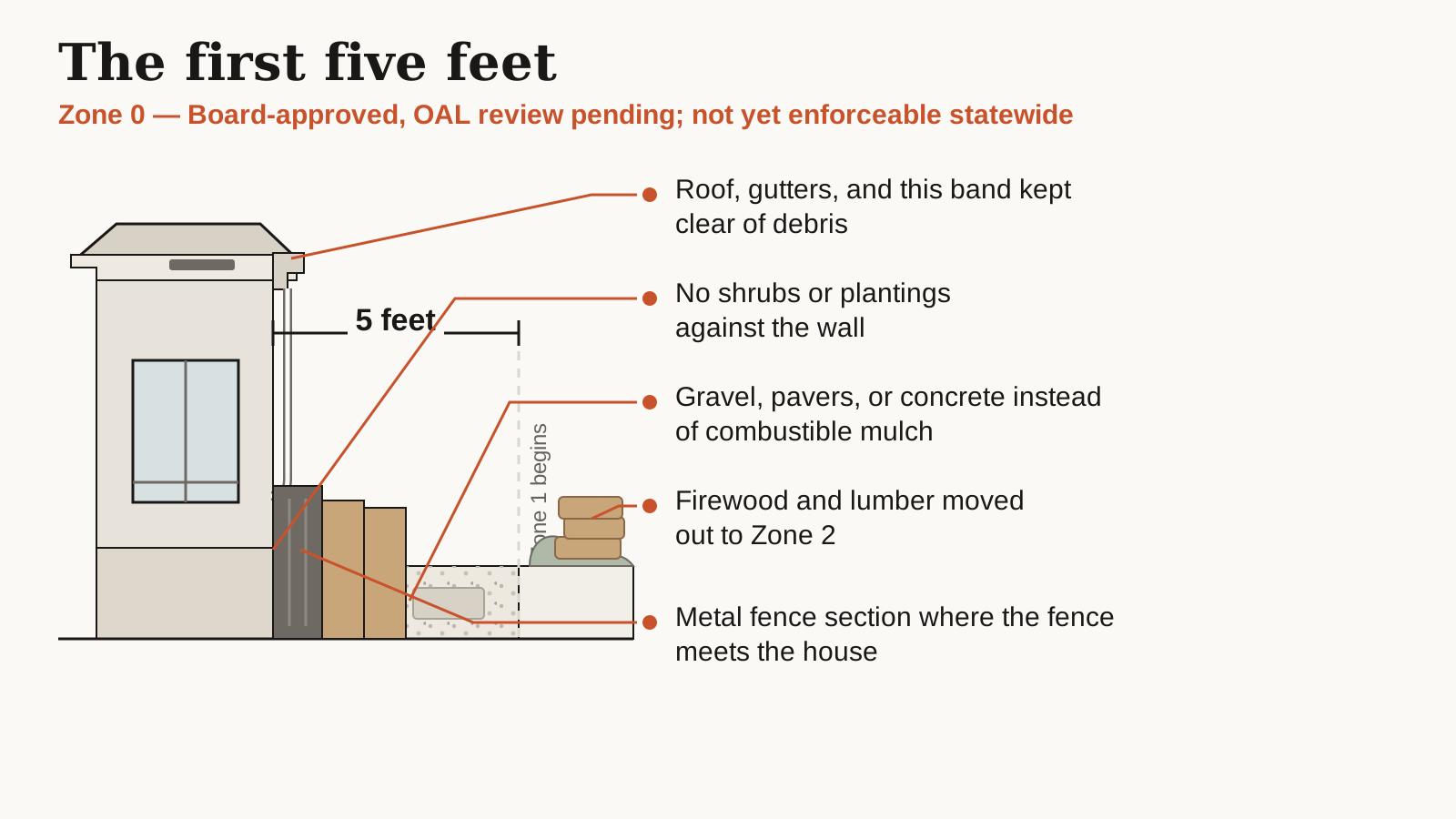
Zone 0 is the ember-resistant zone covering the first five feet around a house. It is the most important area for surviving an ember storm, and the most misunderstood item on the list.
It is in state law, and it is not yet in effect. Public Resources Code section 4291 calls for an ember-resistant zone within five feet of the structure "based on regulations promulgated by the board," then defers it. The requirement does not take effect for new structures until the Board of Forestry and Fire Protection updates its regulations and its guidance document. Existing structures get three more years after that date.
Where the rulemaking stands as of September 1, 2026. The Board of Forestry and Fire Protection approved its Zone 0 emergency rulemaking package on August 19, 2026. It submitted the package to the Office of Administrative Law on August 28, and OAL lists it as pending file 2026-0828-03E. That is Board approval and an active OAL filing, not an effective regulation. OAL says it has 10 calendar days to review an emergency filing and that an approved emergency regulation usually becomes effective when OAL files it with the Secretary of State.
What must still happen. OAL must approve and file the emergency regulation before that regulation becomes effective. Separately, Public Resources Code section 4291 says the statewide ember-resistant-zone requirement does not take effect for new structures until the Board updates both its regulations and its guidance document; existing structures follow three years after the effective date for new structures. CAL FIRE may not change inspection practices, forms, or enforcement for Zone 0 until the State Fire Marshal posts a finding that the Legislature has appropriated sufficient resources.
What this means for you right now: Zone 0 created no statewide legal obligation as of September 1, 2026. A local ordinance, insurer requirement, inspection condition, or construction code can still apply to a particular parcel. The 100-foot defensible-space requirement in Zones 1 and 2 is already law and is unaffected. Recheck OAL's disposition and the Board's guidance before relying on a statewide compliance date.
Do the work anyway. Zone 0 measures already count toward insurance mitigation credit, most of them are inexpensive, and they address the way homes actually ignite. CAL FIRE's current homeowner guidance for the first five feet includes:
- Use gravel, pavers, or concrete instead of combustible mulch.
- Clear dead weeds, grass, and debris, and check roofs, gutters, and outdoor areas.
- Keep branches trimmed at least 10 feet from chimneys and stovepipes.
- Minimize combustible items such as furniture and planters on decks.
- Move firewood and lumber out to Zone 2.
- Replace combustible fencing and gates where they attach to the house.
Where to spend first
- Remove the easy fuel. Clear leaves and needles from the roof, gutters, vents, under decks, and wall corners. Move firewood, trash bins, furniture, and stored material away from the house.
- Create the five-foot ember-resistant zone. Replace combustible mulch next to the structure with gravel, pavers, concrete, or another appropriate noncombustible surface. Break the connection where a wood fence meets the house.
- Address vents and roof edges. Use products and assemblies appropriate for the opening and current code. A screen added in the wrong place can restrict required airflow, so the detail matters.
- Evaluate eaves, siding base, windows, decks, and attachments. These are larger projects, so coordinate them with planned exterior work when practical.
- Keep defensible space maintained. From 5 to 30 feet, manage plants and dead material. From 30 to 100 feet, reduce continuous fuels as the parcel and applicable law require.
What does wildfire retrofitting cost?
There is no responsible single price. The best public research is Headwaters Economics' California retrofit analysis, produced in partnership with CAL FIRE. Two things make it unusually useful here: it is built against California Building Code Chapter 7A, and its cost basis is Northern California, explicitly including the Bay Area.
| Scope level | Examples | Planning range |
|---|---|---|
| Maintenance and Zone 0 cleanup | Debris removal, moving stored items, pruning, replacing small mulch areas | Little to no cost beyond your own time, up to a few thousand dollars with disposal and hardscape |
| Targeted ember-entry retrofit | Ember-resistant vents, deck flashing, gutter work, noncombustible mulch | Roughly $10K–$15K for the study's modeled home |
| Whole-home retrofit, "Good" tier | Highest-value fixes focused on ember entry points | $23K–$40K |
| Whole-home retrofit, "Better" tier | Adds broader envelope work | $40K–$60K |
| Whole-home retrofit, "Best" tier | Comprehensive envelope replacement | $60K–$100K+ |
House size, access, product selection, required permits, drainage, and how much of an assembly must be rebuilt will change any total.
Individual components from the same study give a sense of scale: ember-resistant vents run about $53 each for a circular open-eave vent, roughly $106 installed for an enclosed eave vent, and up to about $420 each for gable-end vents. Class A asphalt fiberglass composition roofing with fire-resistant synthetic underlayment is about $6.29 per square foot, while standing seam metal is about $18.68. Retrofitting a simple 1,000-square-foot wood shake roof to composition shingle came to roughly $6,300, excluding drip edge, ridge vent, and any decay found underneath. Replacing 40 feet of soffit plus vents on one side of a house came to roughly $4,000, as did retrofitting one 480-square-foot wall side with noncombustible siding.
How to turn completed work into useful insurance documentation
Do not wait until after construction to ask what the insurer wants. Before starting:
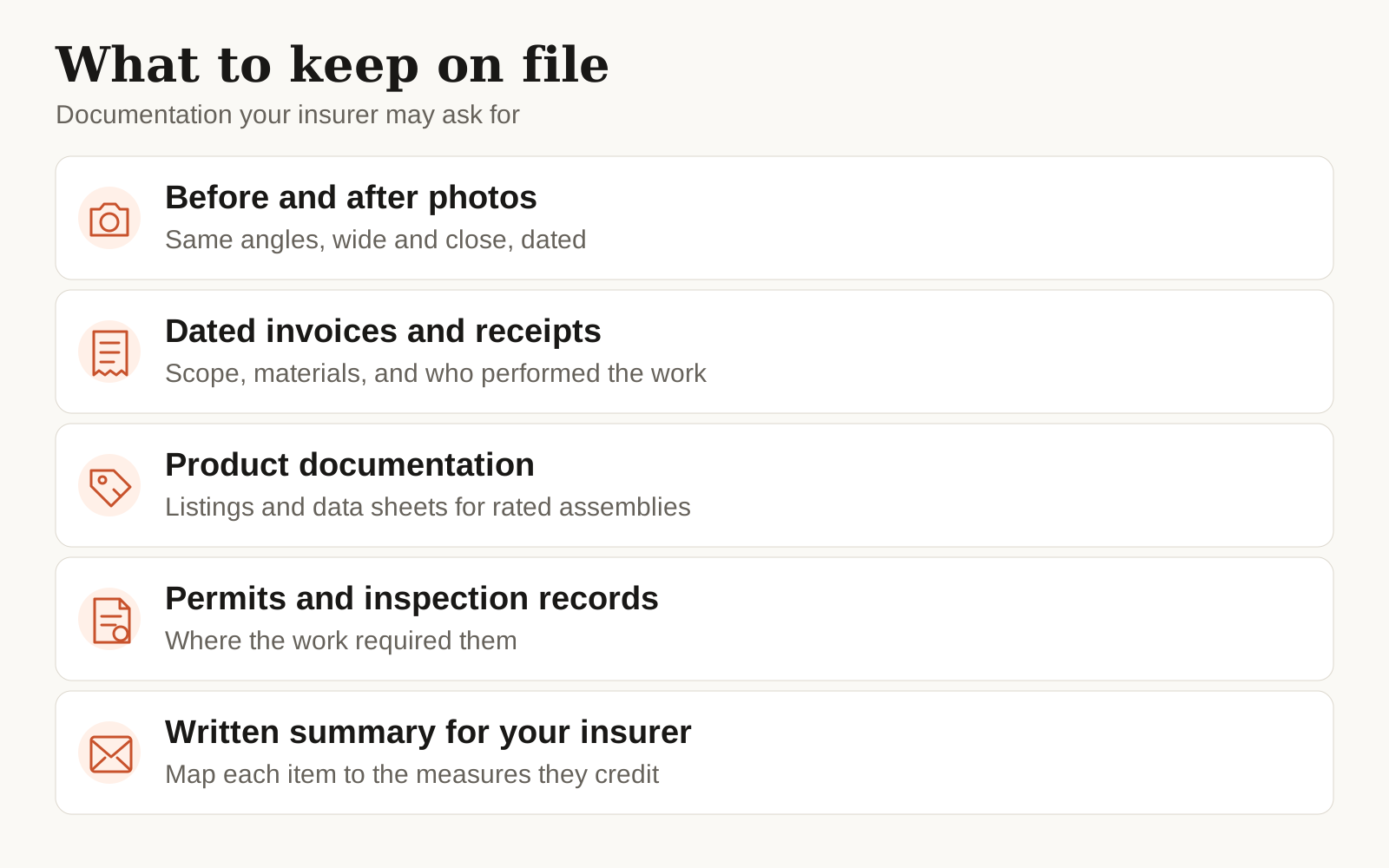
- Ask the insurer or broker for its current wildfire-mitigation form and the exact evidence required for each discount.
- Confirm whether the policy recognizes individual improvements or requires a complete package.
- Take wide and close before photos, then repeat the same views after the work.
- Keep dated invoices, product names, installation instructions, permits, final inspection records, and contractor information.
- Submit the package and ask for a written explanation of any discount or denial.
A discount is not the same as a promise to renew. The regulation says a rate must be "based in part on" reduced risk from mitigation, meaning it is one input among many. Home condition, neighborhood exposure, concentration of risk, and the insurer's lawful underwriting rules can still matter, and a well-hardened home in a severe hazard area can still be priced high.
The proposal that did not pass
You may have read that California is about to require insurers to cover fire-hardened homes. That was a real proposal. It did not become law, and it is worth being precise because the difference is financial.
Senate Bill 1076, officially titled "Admitted insurers: residential property insurance," was introduced on February 13, 2026. As introduced, it would have provided that on and after January 1, 2028, an admitted insurer could not refuse to offer, sell, or renew a residential policy for a property meeting minimum home hardening and wildfire mitigation standards. Those standards were never defined in the bill. It left them for the Insurance Commissioner to establish later by regulation, so there was never a checklist a homeowner could have built toward.
The bill failed passage in the Senate Insurance Committee at its first hearing on April 22, 2026, and the Legislature's record shows no further action since. It has only its introduced version, was never amended, never received a floor vote, and was never chaptered. It imposes nothing on any insurer and gives no protection to any homeowner.
Other bills on this subject continue to be introduced. None of them change what is required today. Treat any pending measure as a possibility rather than a plan, and do not spend money on the assumption that a proposed protection will arrive.
What AB 888's grant program does and does not promise
The California Safe Homes Act was signed on October 10, 2025 as Chapter 536, Statutes of 2025, and took effect January 1, 2026. It added section 2033 to the Insurance Code, creating a Department of Insurance program that prioritizes roof replacement first, then a five-foot noncombustible zone around the structure, then communitywide mitigation.
For an individual applicant, the statute requires the property to be covered by an admitted insurer or the FAIR Plan, located in a ZIP Code that overlaps a high or very high Fire Hazard Severity Zone, and owned by an applicant meeting an income limit. The law also provides that money is available only upon appropriation by the Legislature or receipt of federal or other grant funds.
An appropriation is not the same as an available homeowner grant. AB 888 itself made no appropriation, but the Department of Insurance now reports a $3 million budget appropriation and says it will issue the program's first proof-of-concept grants. As of September 1, 2026, we could not confirm an open direct-homeowner application round, award schedule, or reimbursement process. The statute says the department may adopt rules, eligibility requirements, and additional procedures as needed; it does not require a particular application launch date. Check the Department of Insurance for current status, and do not sign a contract on the assumption that a grant will reimburse it.
Will the work need permits?
Maintenance and simple landscape cleanup generally do not need a building permit. Structural changes, eave enclosure, window or siding work, deck reconstruction, electrical work, and some drainage or hardscape scopes typically do. The answer depends on the city and the exact work.
Ask the building department and fire authority before construction. Permit and final-inspection records also strengthen the documentation you send an insurer.
Combine hardening with planned exterior work
Some wildfire improvements are far cheaper to coordinate when the same surfaces are already open. If you are replacing a roof, siding, windows, or a deck, have the wildfire details reviewed during design rather than added after materials are ordered.
That does not mean rebuilding every exterior surface at once. Start with the weakest ignition paths and coordinate larger upgrades with the normal life of the building.
Questions Bay Area homeowners ask
Is Zone 0 legally required at my house today?
Not as a statewide requirement as of September 1, 2026. The Board approved the emergency rulemaking package on August 19 and filed it with OAL on August 28, but OAL still listed file 2026-0828-03E under review. State law also ties the new-structure requirement to updated regulations and guidance, with existing structures following three years after the new-structure effective date. A local ordinance, insurer requirement, inspection condition, or construction code may still apply to your parcel, and the first five feet already count toward insurance mitigation credit.
Will home hardening stop a nonrenewal?
No guarantee exists. It can reduce physical risk and must be reflected in the rating plans of insurers that price on wildfire risk, but SB 1076's proposed coverage protection failed its first committee vote. Nothing in current California law requires an insurer to offer or renew a policy because a home is hardened.
Does every improvement lower the premium by the same amount?
No. California requires mitigation to be reflected in rating plans, and the Department of Insurance says a plan must contain a separate discount for each mandatory factor, but the credit varies by insurer, policy, property, and measure. The statewide Safer from Wildfires framework does not set one universal percentage for every insurer and home. Ask for the carrier's current form and a written calculation.
Should I replace all my windows first?
Usually not before checking lower-cost weak points such as debris, the first five feet, vents, roof edges, fence connections, and material under decks. Windows can be valuable, especially when replacement is already planned, but the best order is house-specific.
Sources and verification
Legal and program status was checked on September 1, 2026. Recheck before publishing an update or signing a contract tied to insurance or grant eligibility.
- California Department of Insurance: Safer from Wildfires: the mitigation actions and discount framework.
- California Board of Forestry: news releases and announcements: the Board's announcement that it approved the Zone 0 policy at its August 2026 meeting.
- California Board of Forestry: proposed rule packages: the Zone 0 emergency filing materials submitted to OAL.
- Office of Administrative Law: emergency regulations under review: pending Zone 0 file 2026-0828-03E, submitted August 28, 2026.
- Office of Administrative Law: emergency rulemaking process: review timing, approval, filing, and usual effective-date process.
- California Public Resources Code section 4291: current 100-foot duty, Zone 0 regulation-and-guidance trigger, three-year phase-in for existing structures, and inspection-funding condition.
- CAL FIRE Ready for Wildfire: Defensible Space: homeowner guidance and the legal status of each zone.
- California Legislative Information: AB 888: enacted grant-program text, funding contingency, individual eligibility, and discretionary rulemaking authority.
- California Department of Insurance: 2025–2026 letter and look ahead: the reported $3 million budget appropriation and planned proof-of-concept grants.
- California Legislative Information: SB 1076 status: failed passage in committee on April 22, 2026.
- California Legislative Information: AB 2756: 10 percent building-code-upgrade rule, operative for qualifying policies issued or renewed on or after July 1, 2021.
- Headwaters Economics: Retrofitting a Home for Wildfire Resistance: California cost analysis, spring 2024 with a 2023 cost basis. Itemized figures are in the downloadable report, not the landing page.
This guide is general construction and insurance information, not legal, insurance, fire-code, or underwriting advice. It does not create any guarantee about insurance availability, renewal, pricing, or discounts. Cost figures are published research, not a bid from Esquives General Contractors Inc. Home hardening reduces risk; it cannot make any structure fireproof. Coverage, discounts, grants, permits, and property requirements must be confirmed with the responsible insurer and public agency.